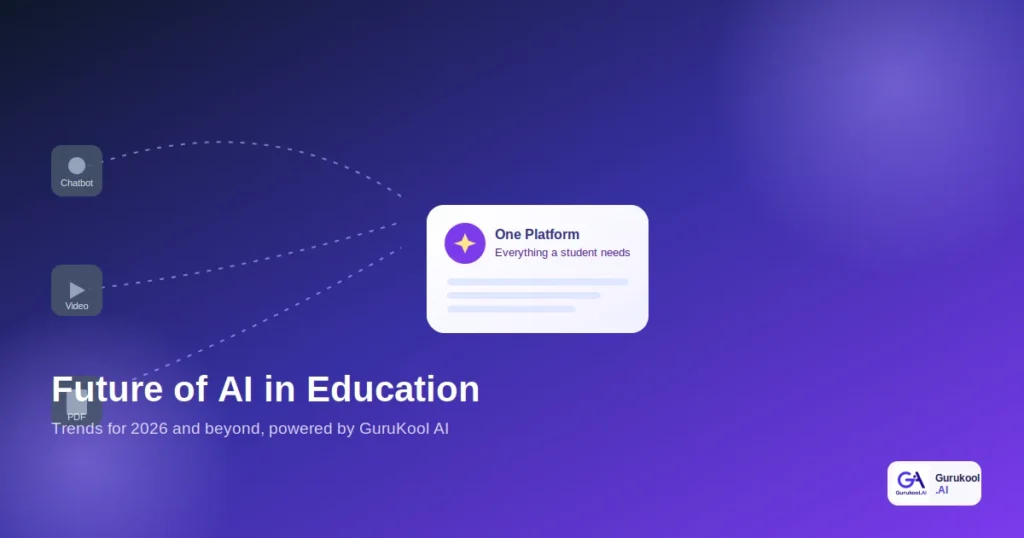
U.S. school districts used an average of 2,591 different edtech tools in a single school year, according to K-12 Dive’s tracking of software licenses. That number sounds impossible until you count how many separate apps one student touches in a single evening: a chatbot for homework help, a video platform for extra explanations, a PDF reader for textbooks, and a notes app to tie it all together. The future of AI in education is not about adding another app to that pile. It is about replacing the pile with one platform that actually works together.
This guide looks at where AI in education is headed through 2030, the trends already reshaping classrooms in 2026, and how a unified platform like GuruKool AI is built for where this is going, instead of where it started. If you are a student comparing tools, a teacher planning next year’s classroom, or a parent trying to make sense of the options, understanding the future of AI in education now will save you from switching platforms twice later.
Why Fragmented AI Tools Are Holding Students Back
Ask most students how they study with AI today, and you will hear a familiar pattern: one app for answers, another for videos, a third for reading, and a fourth for notes. Each tool works fine on its own. The problem shows up in the gaps between them, where context, progress, and time all get lost. Understanding this problem is the starting point for understanding where the future of AI in education is actually headed.
Too Many Apps, Too Little Learning
A typical student toolkit looks something like this:
- A general chatbot for quick answers and explanations
- A video platform for extra lessons on the same topic
- A separate PDF reader or scanner app for textbooks
- A notes app to save summaries and flashcards
- A messaging app to ask a tutor or classmate when all else fails
None of these apps know what the others already explained. A student ends up repeating the same question in three different places, just to get three different, disconnected answers. Multiply that across five subjects and a full school week, and the time lost to app-switching starts to rival the time actually spent learning.
What Happens When Tools Don’t Talk to Each Other
Without shared context, every session starts from zero. The chatbot does not know the student already watched a video on the topic. The notes app does not know which concepts the student is still struggling with. This fragmentation is exactly why the future of AI in education is moving toward consolidation rather than more standalone apps. Every additional app in the stack adds one more place where progress data disappears and one more login a busy student has to remember.
Tired of juggling separate apps for every subject? See how GuruKool AI brings it all into one place.
Key Trends Shaping the Future of AI in Education
Industry data backs up what students already feel. The global AI in education market is projected to grow from roughly ten billion dollars in 2026 to more than forty billion dollars by 2030, and recent Digital Education Council surveys put student AI adoption at 88 percent and faculty adoption at 77 percent across 35 countries. That growth is not just about more people using AI in education. It reflects a deeper shift in how that AI gets delivered, moving away from scattered chat windows toward structured, curriculum-aware platforms. Here is where that growth is actually headed.
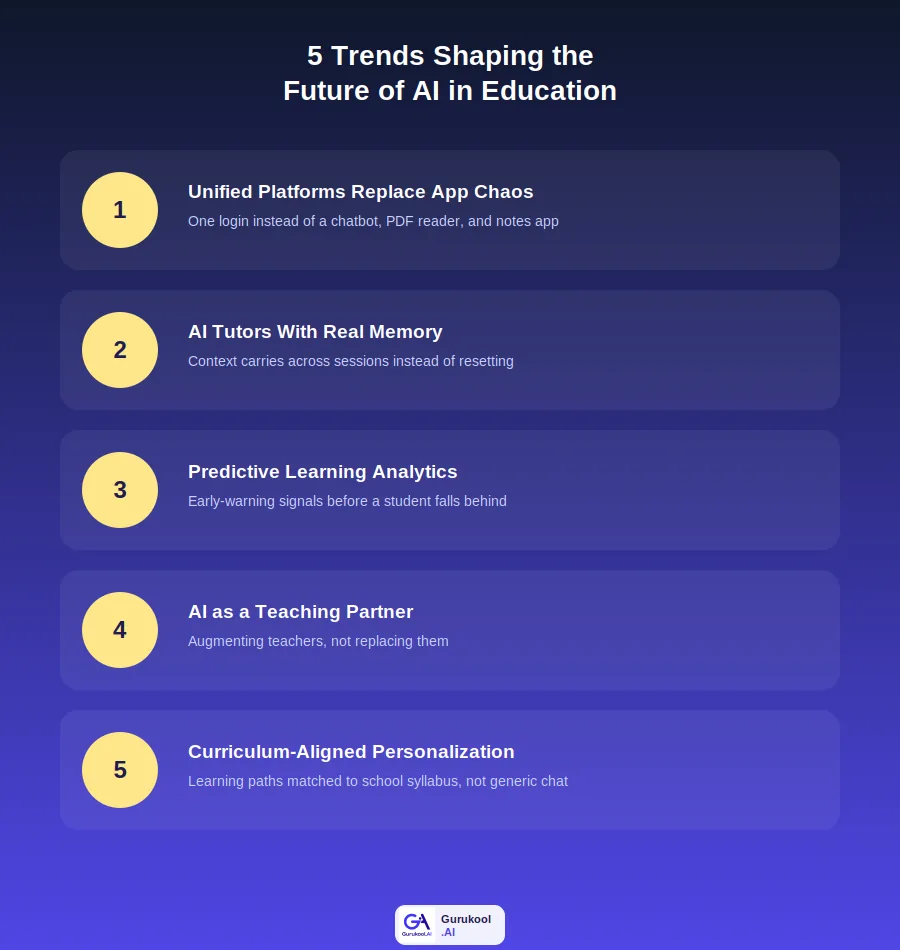
From Add-On Tools to Unified Learning Platforms
2026 marks a visible shift from adding more tools to consolidating them. Schools and ed-tech buyers are actively moving away from app chaos toward unified ecosystems that bundle content, tutoring, and analytics in one place, largely to reduce login fatigue and licensing costs. Vendors that once sold a single narrow feature are now racing to bundle tutoring, content, and analytics together, because buyers increasingly expect a coherent platform for AI in education rather than another point solution to manage.
AI Tutors That Remember Context Across Sessions
Instead of a chatbot that forgets everything after each conversation, the next generation of AI tutor platforms carries context forward, remembering what a student already covered so explanations can build on real progress rather than starting over every time. This single change, memory across sessions, is arguably the biggest shift separating today’s AI in education tools from where the category is headed next.
Predictive, Real-Time Learning Analytics
A 2026 K-12 edtech survey found that 71 percent of school leaders see high value in AI-powered early-warning systems that flag students at risk of falling behind before a report card ever shows it. This kind of predictive analytics is becoming a core expectation, not an optional add-on, and it only works well when the underlying platform for AI in education has access to a student’s full history rather than fragments spread across separate tools.
Why All-in-One Platforms Are the Future of AI in Education
Consolidation is not just a cost-saving trend. It changes how well a student actually learns.
Less App-Switching, More Actual Studying
Every switch between apps costs a few minutes of lost focus while a student re-opens context, re-reads a question, or re-finds where they left off. Over a school year, those minutes add up to real study time lost to logistics instead of learning. Cutting that friction is one of the clearest, most measurable benefits of moving toward a unified vision of AI in education instead of a pile of disconnected tools.
One Progress Dashboard Instead of Five
When homework help, video lessons, notes, and practice questions each live in a different app, no single dashboard shows the full picture. A unified platform ties every interaction back to one profile, so progress is visible in one place instead of scattered across four logins. Parents comparing options for AI in education consistently name this single dashboard as one of the biggest practical differences over a school year.
Lower Total Cost Than Multiple Subscriptions
Paying for a premium chatbot, a video subscription, and a separate study app adds up fast. A single subscription covering all of it is usually the more affordable path, especially for families managing more than one child’s education at once.
See the real cost difference for yourself. Compare GuruKool AI’s all-in-one plan against your current app stack.
Fragmented Tools vs an All-in-One AI Learning Platform
Here is how a typical fragmented toolkit compares to a unified platform built specifically for the future of AI in education. The differences show up most clearly in daily habits: how many times a student logs in, how much gets lost between sessions, and how much a family actually pays each month.
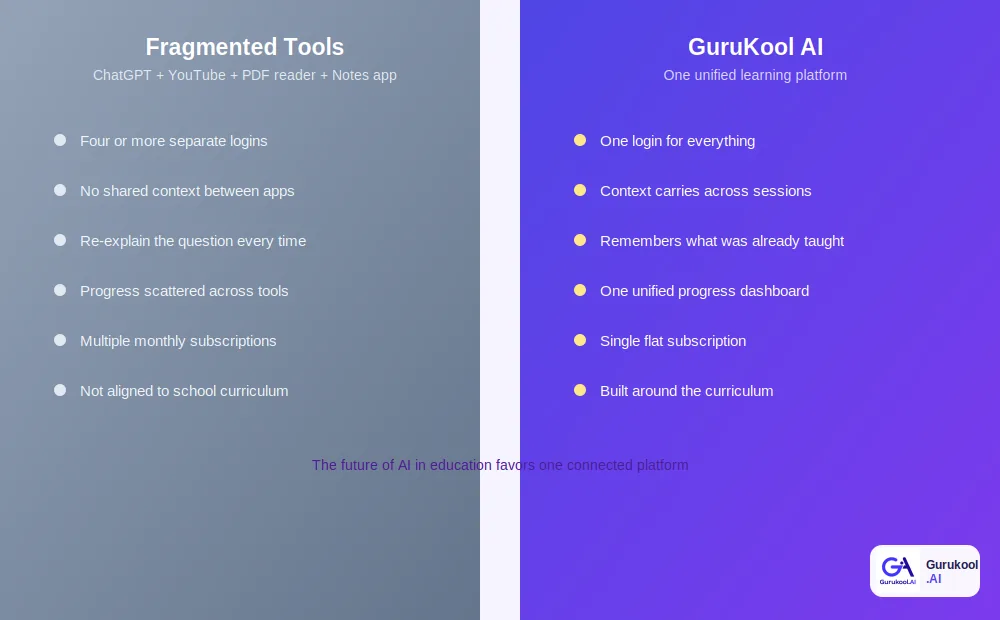
Fragmented apps versus one connected AI learning platform
| Factor | Fragmented Tools (ChatGPT + YouTube + PDF + Notes) | Unified Platform (GuruKool AI) |
|---|---|---|
| Logins required | Four or more separate accounts | One login for everything |
| Context continuity | Resets with every new app | Carries forward across sessions |
| Progress tracking | Scattered, often none at all | One unified analytics dashboard |
| Visual explanations | Depends on the app, inconsistent | Built-in interactive whiteboard |
| Curriculum alignment | Generic, not syllabus-specific | Aligned to school curriculum |
| Monthly cost | Multiple stacked subscriptions | Single flat subscription |
Cost and Subscriptions
Stacking three or four premium subscriptions quietly costs more than most families realize until they add up the monthly charges. A single subscription that replaces all of them is usually the cheaper and simpler option, and it is one of the more practical reasons schools and parents are moving toward a consolidated view of AI in education rather than paying for every tool separately.
Data and Progress Continuity
A fragmented toolkit means a parent or teacher has to check four different apps to understand how a student is actually doing. A unified platform keeps that data in one place, which is a core reason the future of AI in education favors consolidation over add-ons. It also means a teacher reviewing a struggling student’s progress does not have to guess which app holds the missing piece of the story.
How GuruKool AI Is Built for the Future of AI in Education
Instead of asking students to piece together a chatbot, a PDF reader, a video app, and a notes app, GuruKool AI combines all of it into a single platform built specifically for learning.
The trends behind where AI in education is headed next
One Login, Six Core Tools
Everything a student needs lives in one account:
- AI Tutor: instant, step-by-step answers at any hour
- Interactive Whiteboard: visual explanations for tough concepts
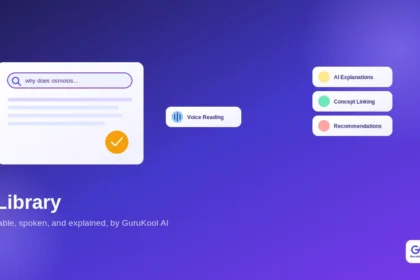
- Smart Library: curriculum-aligned recommendations
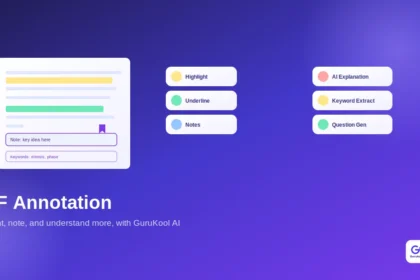
- PDF Annotation: textbooks turned into interactive study guides
- Personalized Learning: pace and depth matched to the student
- Learning Analytics: one dashboard tracking progress over time
Continuous Personalization Instead of One-Off Chats
A general chatbot treats every question as a fresh conversation. GuruKool AI keeps track of what a student has already learned, so a question asked today builds on last week’s explanation instead of starting from scratch. This is the core difference between a generic assistant and a platform built for the future of AI in education.
Built for Curriculum, Not Just Conversation
General-purpose chatbots are not designed around a specific school syllabus. GuruKool AI’s Smart Library and Personalized Learning features are built around curriculum content, so explanations, practice questions, and recommendations stay aligned to what a student is actually being tested on. That distinction, curriculum-first versus conversation-first, is likely to define which platforms lead the future of AI in education over the next several years.
See it in action. Book a free GuruKool AI walkthrough and compare it against your current study apps.
What’s Next for Schools, Teachers, and Students
The most reliable research consensus on the future of AI in education, including analysis from McKinsey and OECD Education 2030, is that AI augments teachers rather than replacing them.
AI as a Teaching Partner, Not a Replacement
A recent longitudinal study of more than 8,000 educators found that 87 percent reported AI increased their job satisfaction, largely by cutting busywork and freeing up time for mentoring. Georgia State University’s AI-powered advising system offers a concrete example: it helped raise graduation rates by 7 percent across roughly 22,000 students, simply by flagging at-risk students earlier than a human advisor could alone. Results like these are a big part of why the future of AI in education is being written by teachers and administrators, not just software vendors.
Smart Classrooms Through 2030
Expect cloud-based, mobile-first platforms to keep gaining ground, while immersive tools like classroom VR remain a slower-moving trend limited mostly to schools with strong bandwidth and budget. The more immediate shift is software consolidation: fewer logins, more shared data, and AI woven into daily lesson planning rather than treated as a separate add-on. By the time most of today’s forecasts for AI in education play out, the winning platforms will likely be judged less on flashy features and more on how well they fit into a normal school day.
Preparing Students Today for Tomorrow’s Classroom
Getting ready for where AI in education is headed does not require waiting for 2030. Most of the groundwork can start this semester, with tools that already exist today. Here is a simple way to start now:
- Pick one unified platform instead of collecting separate apps for chat, video, and notes.
- Move existing textbooks and PDFs into that platform’s annotation tool.
- Let the platform’s analytics flag weak topics instead of guessing from test scores alone.
- Use the built-in whiteboard for any concept that is hard to picture in text.
- Review the progress dashboard weekly instead of only checking report cards.
Following that sequence turns the future of AI in education from an abstract trend into a weekly study habit.
Frequently Asked Questions About the Future of AI in Education
What does the future of AI in education look like by 2030?
By 2030, expect fewer standalone apps and more unified platforms that combine tutoring, content, and analytics in one place. Market analysts project the global AI in education market to exceed forty billion dollars by then, driven by personalized learning, predictive analytics, and consolidation away from today’s fragmented tool stacks.
Will AI replace teachers in the future of AI in education?
No. Research from McKinsey and OECD Education 2030 consistently finds that AI augments teaching rather than replacing it. AI handles repetitive explanations and routine grading, freeing teachers for mentoring, discussion, and the human judgment calls that software cannot make on its own.
Why are schools moving away from multiple separate AI apps?
Fragmented tools create login fatigue, scattered progress data, and stacked subscription costs. Districts managing thousands of individual tool licenses are shifting toward unified ecosystems that bundle tutoring, content, and analytics, reducing both cost and the daily friction of switching between disconnected apps.
How is GuruKool AI different from using ChatGPT for studying?
ChatGPT treats each conversation separately and is not built around a school curriculum. GuruKool AI remembers a student’s learning history, aligns content to the actual syllabus, and adds visual tools like an interactive whiteboard and progress analytics that a general-purpose chatbot does not include.
Is it worth switching to an all-in-one AI learning platform now?
Yes, especially for students juggling several subjects or subscriptions already. Switching now means one login, consolidated progress data, and typically a lower total cost than paying for a chatbot, a video service, and a notes app separately, while also getting ahead of where AI in education is clearly headed.
Conclusion
The future of AI in education is not about collecting more apps. It is about replacing app chaos with one platform that remembers context, tracks real progress, and stays aligned to what a student is actually studying. With adoption already above 88 percent among students and the market on track to more than triple by 2030, the shift toward unified, curriculum-aligned learning platforms is no longer a prediction. It is already underway, and the schools and families who move early will spend less time managing tools and more time actually learning from them.
GuruKool AI is built for exactly this shift, bringing the AI Tutor, Interactive Whiteboard, Smart Library, PDF Annotation, Personalized Learning, and Learning Analytics into one connected platform instead of five disconnected apps. For students, teachers, and parents alike, that consolidation is the clearest sign of where this technology is actually going next.
Ready to move from app chaos to one connected platform? Start a free GuruKool AI demo and see the future of AI in education in action today.
Sources: ClassPoint, 2026 EdTech Trends; X-Pilot AI, The Future of AI in Education: 2026 Trends Report.