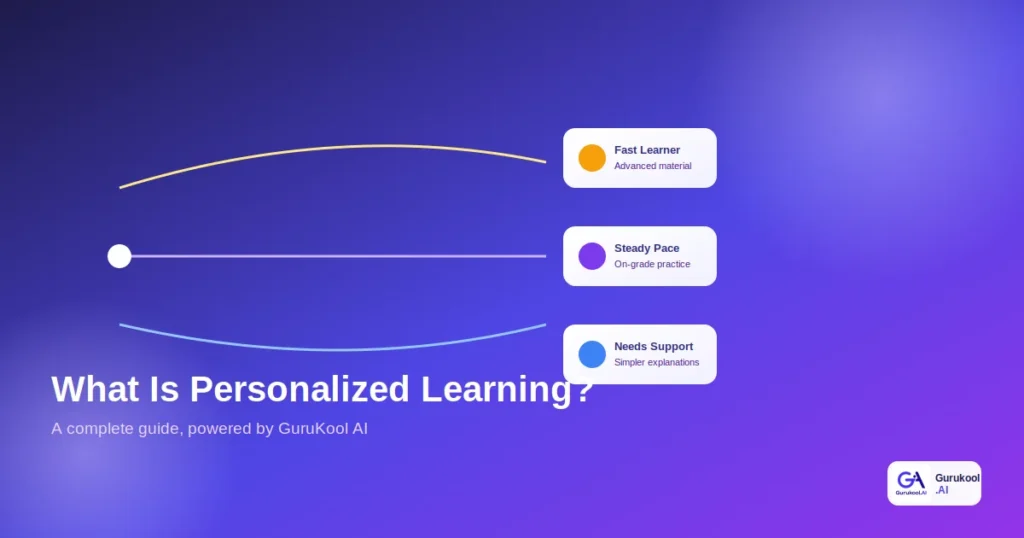
Picture two students in the same tenth-grade math class. One finishes every problem set in ten minutes and gets bored waiting for the lesson to move on. The other needs three extra explanations of the same concept and still falls behind before the teacher notices. Same classroom, same teacher, same textbook, completely different needs. This is the exact problem personalized learning is designed to solve.
This guide explains what personalized learning actually means, why it works better than one-size-fits-all teaching, and how a platform like GuruKool AI puts personalized learning into practice for students, teachers, and schools every day. If you have already read our guide on the core benefits of AI in education, personalized learning is one of the biggest reasons those benefits actually show up in daily study sessions.
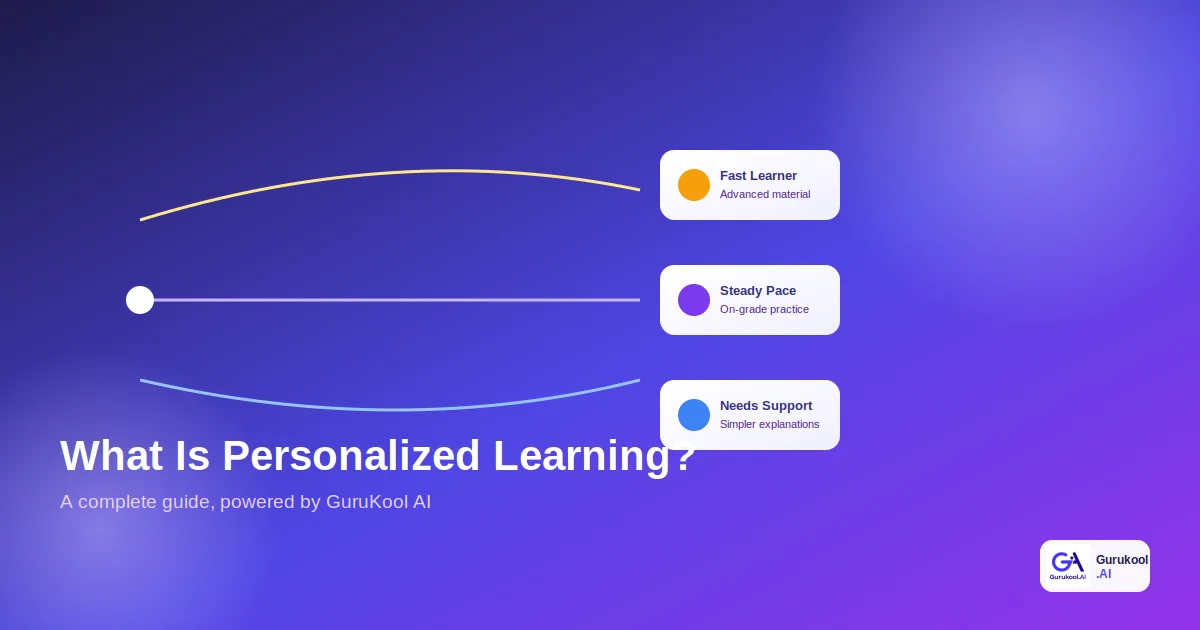
The Problem With One-Size-Fits-All Classrooms
Classrooms are built around averages. A teacher plans one lesson, delivers it once, and moves on to the next topic on a fixed schedule. That structure works for the students sitting near the middle of the pace curve. It works far less well for everyone else.
Why Every Student Learns at a Different Pace
Some students grasp a new concept the first time it is explained. Others need it broken into smaller steps, repeated with different examples, or shown visually before it clicks. Neither speed is better or worse. They are just different, and a single 40-minute lesson cannot realistically serve both at once. Learning researchers have long pointed out that the gap between the fastest and slowest learners in a typical classroom can span several grade levels by the time students reach middle school, simply because small differences in pace compound year after year.
What Gets Lost When Teaching Aims at “The Middle”
When a lesson is paced for the average student, two things happen at the edges. Faster students disengage because there is nothing new to hold their attention. Slower students quietly fall behind because there is no time built in to slow down. Both groups lose real learning time, just in opposite directions. Over a full school year, that lost time adds up: a student who is consistently under-challenged loses motivation, while a student who is consistently over-challenged starts to associate the subject with frustration instead of curiosity.
What Is Personalized Learning?
Personalized learning is an approach to education where the pace, depth, and format of instruction adjust to fit each individual student, instead of delivering the same lesson the same way to everyone. It uses data about what a student already knows, where they struggle, and how they learn best to shape what comes next. That data can come from quiz scores, time spent on a problem, questions asked, or even which explanation format a student tends to respond to best.
Personalized Learning vs Traditional Teaching
Traditional teaching starts with a fixed lesson plan and delivers it to the whole class at once. This approach instead starts with the student profile: what they have mastered, what they are missing, and what explanation style works for them. The lesson content can be the same; the delivery is not, and that difference in delivery is often what determines whether a concept actually sticks.
Personalized Learning vs Adaptive Learning
These two terms get used interchangeably, but they are not identical. Adaptive learning usually refers to the technology that adjusts content difficulty in real time, based on how a student answers questions. Personalized learning is the broader goal, adaptive technology is one of the tools used to achieve it, alongside personalized explanations, pacing, and format. Think of it this way: adaptive learning is the engine, and this broader goal is the destination it is trying to reach. A platform can be adaptive without being fully personalized, if it only adjusts difficulty but ignores explanation style, pacing preferences, or format.
Real Examples of Personalized Learning in Practice
This broader approach shows up in different forms depending on the subject and the student:
- A struggling student gets a simpler, step-by-step explanation instead of the standard textbook version
- A fast learner receives advanced practice problems instead of repeating mastered material
- A visual learner sees a concept drawn out on an interactive whiteboard instead of just reading text
- A student’s progress dashboard flags a weak topic before it shows up on a report card
Why Personalized Learning Works: The Evidence
Personalized learning is not just a comforting idea. Market and outcome data back it up. The global personalized learning market was valued at roughly 18.4 billion dollars in 2025 and is projected to more than double within the decade, and 74 percent of educational institutions now say personalized education is a priority, according to recent adaptive learning market research. That level of institutional buy-in suggests this is a durable shift, not a passing trend.
Better Engagement and Retention
Higher education platforms that added personalized recommendation engines and adaptive assessments have reported learner engagement increases in the range of 35 to 45 percent. When the material actually matches what a student needs next, they stay engaged instead of tuning out. Online course providers such as edX and Udacity have pointed to this same pattern: courses that recommend the next lesson based on a learner’s actual performance see meaningfully higher completion rates than courses that push everyone through an identical, linear syllabus.
Catching Learning Gaps Early
Roughly 78 percent of higher education institutions have already adopted some form of adaptive learning technology, largely because it surfaces gaps in real time instead of waiting for a test to reveal them. That earlier signal gives teachers and students more time to fix a problem before it compounds. A gap in fractions that goes unnoticed in fourth grade, for example, tends to resurface as a much bigger obstacle by the time algebra shows up two years later.
Keeping Fast Learners Challenged
This individualized approach is not only about slowing down for students who struggle. It also means recognizing when a student is ready to move faster, so advanced learners are not stuck redoing material they have already mastered while waiting for the rest of the class.
Want to see personalized learning working for your child’s actual pace? Try GuruKool AI’s Personalized Learning feature free.
Personalized Learning vs Traditional Classrooms: A Side-by-Side Comparison
The table below lines up the two approaches directly, so the practical differences are easy to see at a glance.
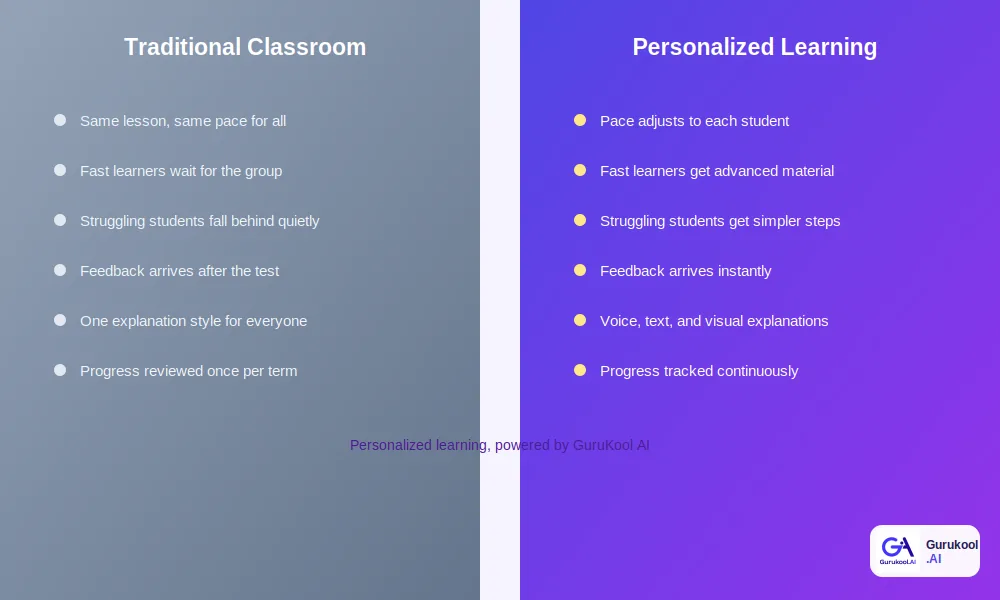
Personalized learning compared to a traditional, one-pace classroom
| Factor | Traditional Classroom | Personalized Learning (GuruKool AI) |
|---|---|---|
| Pace | Fixed for the whole class | Adjusts to each student |
| Explanation style | One format for everyone | Voice, text, or visual diagrams |
| Feedback speed | After the next test or assignment | Instant, in the moment |
| Support for fast learners | Limited, often repeats material | Advanced content unlocked automatically |
| Support for struggling students | Extra help only if requested | Simpler explanations offered automatically |
| Progress visibility | Report cards a few times a year | Continuous tracking dashboard |
Pace and Flexibility
A traditional classroom has one throttle for thirty different students. This individualized approach gives each student their own, so nobody is stuck waiting or left behind by the same fixed schedule.
Feedback Speed
Traditional feedback loops run on the calendar: a quiz on Friday, a test in two weeks, a report card next month. This faster, individualized approach shortens that loop to minutes, which matters because a misunderstanding caught today is far easier to fix than one caught after a month of building on the wrong foundation.
How GuruKool AI Delivers True Personalized Learning
Knowing what personalized learning should look like is one thing. Delivering it consistently, across every subject and every student, is what GuruKool AI is built to do.
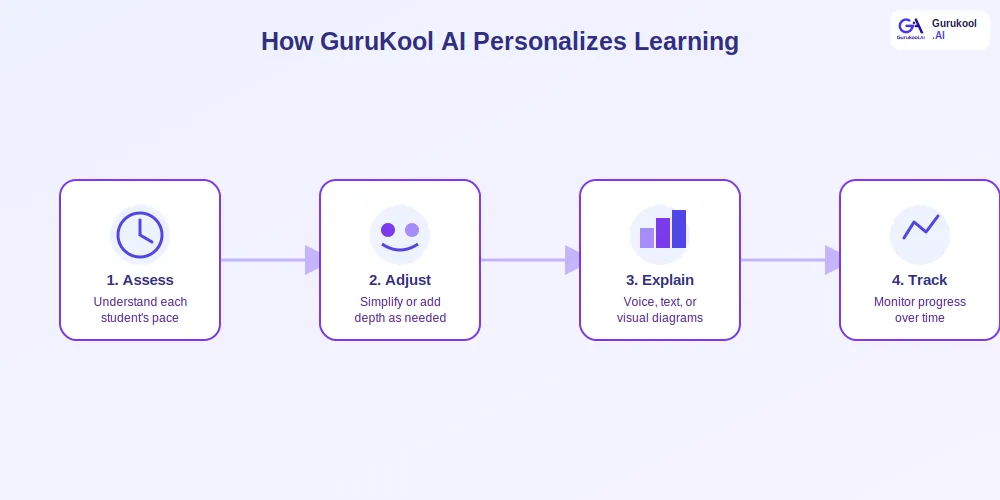
The four-step loop behind GuruKool AI’s personalized learning
Understanding Each Student’s Pace
GuruKool AI tracks how a student responds to each topic, not just whether an answer is right or wrong. If a student consistently needs more time or more examples on a concept, the platform adjusts pacing automatically instead of waiting for a parent or teacher to flag it manually. It also notices the opposite pattern: when a student answers quickly and correctly across several questions in a row, the system treats that as a signal to introduce harder material rather than continuing to repeat content the student has already mastered.
Voice, Text, and Interactive Drawing
Not every student learns the same way from the same format. GuruKool AI offers explanations through voice conversation, written text, and an interactive whiteboard for drawing out diagrams, so a concept can be explained however it actually clicks for that student, whether that is hearing it, reading it, or seeing it drawn step by step. A geometry proof might click faster when it is drawn out line by line, while a vocabulary concept might land better as a short spoken explanation a student can listen to while reviewing notes.
Tracking Progress Continuously
Every interaction feeds into a learning analytics dashboard, so this kind of personalization is not a one-time setup. It keeps adjusting as the student’s understanding changes week to week, which is very different from a static learning plan that never updates itself. A student who struggled with a topic in September and mastered it by November should not still be receiving beginner-level explanations in December simply because nobody updated the plan.
- Understands each student’s pace instead of applying one fixed speed
- Gives easier explanations automatically when a student struggles
- Unlocks advanced material for students who are ready to move faster
- Uses voice, text, diagrams, and interactive drawing to match learning style
- Tracks learning progress continuously instead of only at test time
Curious how this looks for your specific subject? Book a free GuruKool AI personalized learning demo today.
Personalized Learning in Action: A Real Classroom Scenario
It helps to see this approach play out with two real students in the same class, on the same day, working on the same chapter. The scenario below is simplified, but it reflects the kind of moment-to-moment difference personalized instruction makes in an ordinary lesson.
A Struggling Student Gets Simpler Explanations
A ninth grader is stuck on quadratic equations. Instead of re-reading the same textbook paragraph a third time, the platform steps in with a simplified, visual breakdown of the formula, one small piece at a time, until the underlying pattern actually makes sense. Ten minutes earlier, that same student might have quietly given up and copied an answer from a classmate just to move on, which is exactly the kind of silent struggle a fixed-pace lesson often misses.
A Fast Learner Gets Advanced Material
Across the same classroom, another student finishes the same worksheet in half the time. Rather than sitting idle, the platform offers a slightly harder problem set that stretches the same topic further, keeping the lesson challenging instead of repetitive. Without that extra material, this student would likely spend the remaining class time distracted, which over a school year adds up to a surprising amount of wasted potential for someone who is actually ahead of schedule.
Here is what that personalized session typically looks like end to end:
- The student opens GuruKool AI and starts the day’s topic.
- The platform checks recent performance on related concepts.
- Explanations adjust automatically, simpler for one student, more advanced for another.
- The Interactive Whiteboard illustrates any concept that needs a visual.
- Learning Analytics logs the session and updates each student’s progress profile.
Both students finish the same class period having actually learned something new, instead of one being bored and the other being lost. To see how this fits into the bigger picture, our guide on where AI in education is headed next covers how unified, personalized platforms are becoming the standard rather than the exception.
Before wrapping up, here are answers to a few of the most common questions parents, students, and teachers ask when they first start comparing personalized learning tools against a standard classroom setup or a generic study app.
Frequently Asked Questions About Personalized Learning
What is personalized learning in simple terms?
Personalized learning means adjusting the pace, depth, and format of a lesson to fit an individual student, instead of teaching everyone the same way at the same speed. It uses data about what a student knows and how they learn best to decide what to teach next and how to explain it.
How is personalized learning different from adaptive learning?
Adaptive learning is a technology that adjusts content difficulty automatically based on student responses. Personalized learning is the broader goal of tailoring the entire learning experience, pace, format, and feedback, to the individual. Adaptive learning is one tool used to achieve personalized learning, not a separate concept.
Does personalized learning actually improve results?
Yes. Platforms that added personalized recommendation engines and adaptive assessments report engagement increases of 35 to 45 percent in some studies, and institutions using adaptive technology catch learning gaps earlier than those relying on periodic testing alone. Results vary by subject and implementation, but the overall trend is positive.
How does GuruKool AI personalize learning for each student?
GuruKool AI tracks how a student responds to each topic and adjusts explanation depth, pace, and format accordingly. It offers voice, text, and interactive whiteboard explanations, and continuously updates a learning analytics dashboard so pacing keeps adjusting as the student’s understanding changes over time.
Is personalized learning only useful for struggling students?
No. Personalized learning helps students at every level. Struggling students get simplified, step-by-step explanations, while fast learners get advanced material instead of repeating what they already know. The goal is matching pace to the individual, not just supporting students who are behind.
Conclusion
Personalized learning is not about giving every student a completely different curriculum. It is about adjusting pace, depth, and explanation style so the same core material actually reaches each student in a way that makes sense to them. With institutions increasingly treating personalized education as a baseline expectation rather than an extra feature, this shift is becoming the norm rather than the exception. Waiting until a student falls behind to introduce this kind of support means losing months that are much harder to make up later.
GuruKool AI builds personalized learning directly into its AI Tutor, Interactive Whiteboard, and Learning Analytics, so pace, format, and progress tracking work together automatically instead of requiring a separate setup for every subject. Students, teachers, and parents all see the same progress data, which keeps everyone working from the same picture instead of guessing.
Ready to see personalized learning fit your child’s actual pace? Start a free GuruKool AI demo and watch the lesson adjust in real time.
Sources: Grand View Research, Adaptive Learning Market Report; Dataintelo, Personalized Learning Market Research Report.