A well-known study of Knewton’s adaptive learning program found that students using it improved their test scores by 62 percent compared to students who did not use any adaptive tool at all. That is not a small edge. That is the difference between passing and excelling, and it comes from one core idea: adaptive learning adjusts to what a student actually needs, instead of pushing everyone through the same fixed worksheet.
This guide breaks down what adaptive learning actually is, how it works step by step, and how GuruKool AI builds it directly into everyday studying. If you have already read our guide on what personalized learning means, adaptive learning is the specific engine that makes much of that personalization possible. Understanding the mechanics behind it also makes it much easier to judge whether a study tool is genuinely adaptive or simply calling itself that in marketing copy.
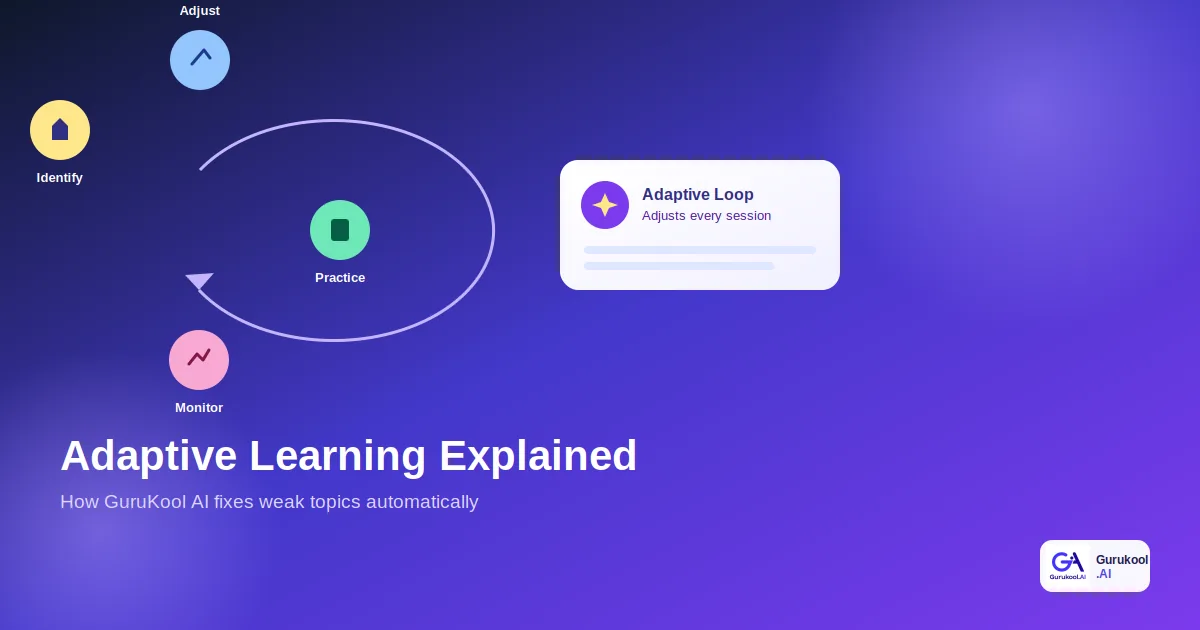
What Is Adaptive Learning?
Adaptive learning is a technology-driven approach where the difficulty, format, and sequence of content adjust automatically based on how a student is actually performing. Instead of a fixed lesson plan, the system reacts to every answer, building a live picture of what a student knows and does not know yet. That picture updates continuously, which is very different from a paper workbook that stays exactly the same no matter how a student performs on it.
How Adaptive Learning Works Behind the Scenes
Most adaptive systems rely on some combination of knowledge tracing and performance analysis: tracking which specific skills a student has demonstrated, how confidently, and how recently. When a student answers a question incorrectly, the system does not just mark it wrong. It updates its model of that student’s understanding and changes what comes next, whether that means an easier follow-up question, a different explanation, or extra practice on the same skill. Some systems use Bayesian knowledge tracing, others lean on simpler rules-based logic, but the underlying goal is the same: build an accurate, constantly updating picture of what one specific student knows right now.
Adaptive Learning vs Personalized Learning
These terms overlap, but they are not the same thing. Personalized learning is the broader goal of matching pace, depth, and format to an individual student. Adaptive learning is the specific mechanism, usually software-driven, that makes real-time adjustments possible. You can think of this mechanism as the engine and personalized learning as the destination it is built to reach.
Want to see this engine at work on your own study material? Try GuruKool AI’s adaptive practice free.
Why Adaptive Learning Actually Improves Results
The case for this approach is not just theoretical. The global adaptive learning market was valued at roughly 4.52 billion dollars in 2026 and is projected to reach 21.54 billion dollars by 2035, and 74 percent of institutions now say personalized, adaptive education is a priority rather than a nice-to-have extra.
Faster Time to Mastery
One case study on an AI-driven adaptive platform found it decreased time to proficiency by 28 percent while maintaining or improving mastery levels, and 97 percent of educators involved reported the platform gave them useful insight into when to step in. Less time spent on material a student has already mastered means more time available for the topics that actually need attention. In that same pilot, student satisfaction scores rose from 3.2 out of 5 to 4.7 out of 5, suggesting the efficiency gain did not come at the cost of a worse experience.
Catching Weak Topics Before They Compound
A scoping review of adaptive learning research in higher education found that 59 percent of the studies reviewed reported improved academic performance among students using adaptive platforms. The mechanism is straightforward: a weak topic flagged in week two is far easier to fix than the same gap discovered in week twelve, after several other lessons have already been built on top of it. This is especially true in subjects like math and language learning, where each new unit assumes mastery of everything that came before it, so an unnoticed gap early on tends to resurface, often in a more confusing form, several chapters later.
Higher Engagement, Lower Dropout
Research on an adaptive alternative to a standard online course format found student engagement was 72 percent higher than in the traditional, one-size-fits-all version of the same course. When practice actually matches a student’s current level, it feels productive instead of frustrating, which keeps students coming back instead of quietly disengaging. Similar patterns show up in specialized settings too. Arizona State University’s cybersecurity lab platform, which adjusts virtual lab content to match each learner’s style, improved grades for 65 percent of the students who used it, a meaningful jump for a subject often considered intimidating for newcomers.
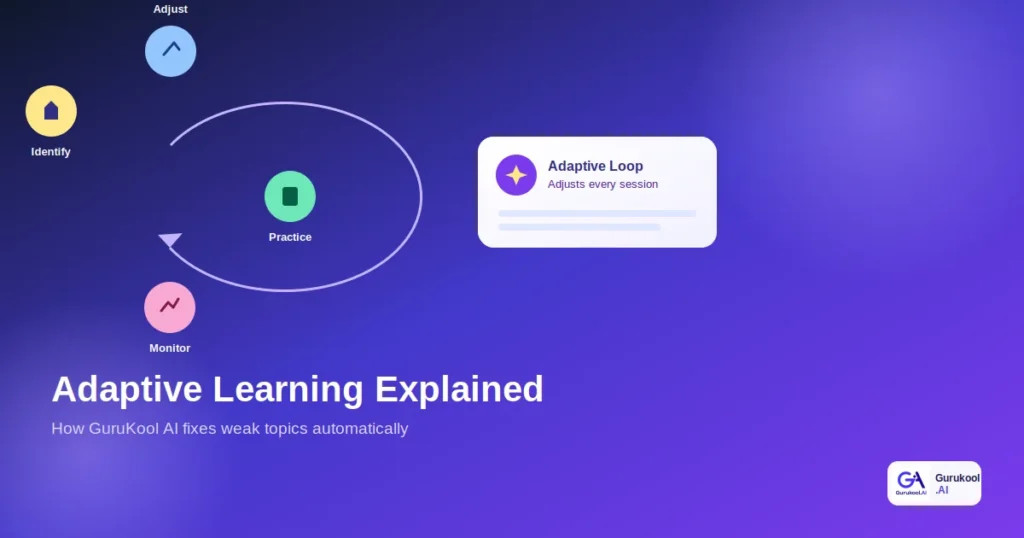
The Five-Step Adaptive Learning Loop
This process is not a single feature. It is a loop that repeats every time a student studies, and it is worth walking through each step individually, since understanding the mechanics makes it much easier to spot a genuinely adaptive tool versus one that only adjusts difficulty on the surface:
- Identify the specific topics where a student is weak, based on recent answers and response patterns.
- Recommend the most relevant content to address that exact gap, instead of a generic next lesson.
- Explain the concept differently if the first explanation did not land, using a new format or example.
- Practice continuously with questions targeted at the weak skill until it is genuinely mastered.
- Monitor improvement over time, feeding fresh data back into the next identification step.
Steps 1 and 2: Identify Weak Topics and Recommend Content
Everything starts with an accurate read on where a student actually stands. Once a weak topic is identified, the system pulls the most relevant material for that specific gap, rather than assigning the next chapter in a fixed sequence regardless of readiness. This is the step where most fixed curricula fall short: a printed workbook cannot look at a student’s last ten answers and decide what to assign next, but a system built around this loop can, every single time.
Steps 3 and 4: Explain Differently and Provide Continuous Practice
If a student does not understand an explanation the first time, repeating the exact same explanation rarely helps. Adaptive systems switch the approach, a diagram instead of text, a simpler example, a different analogy, and then reinforce it with practice questions until the concept sticks. This is a small but important departure from how most textbooks are written, since a textbook offers exactly one explanation per concept and simply hopes it works for every reader.
Step 5: Monitor Improvement Over Time
The loop only works if it keeps checking its own results. Continuous monitoring confirms whether the adjustment actually helped, and feeds that result back into the system so the next recommendation is even better informed than the last one. Without this final step, a system could keep recommending the same explanation style indefinitely, even if it never actually worked for a particular student, simply because nobody was checking whether it landed.
See adaptive learning find a real weak spot in minutes. Book a free GuruKool AI adaptive learning demo and watch it happen live on your own material.
Adaptive Learning vs Traditional Practice: A Side-by-Side Comparison
Here is how this approach stacks up against the fixed-worksheet approach most classrooms still rely on.
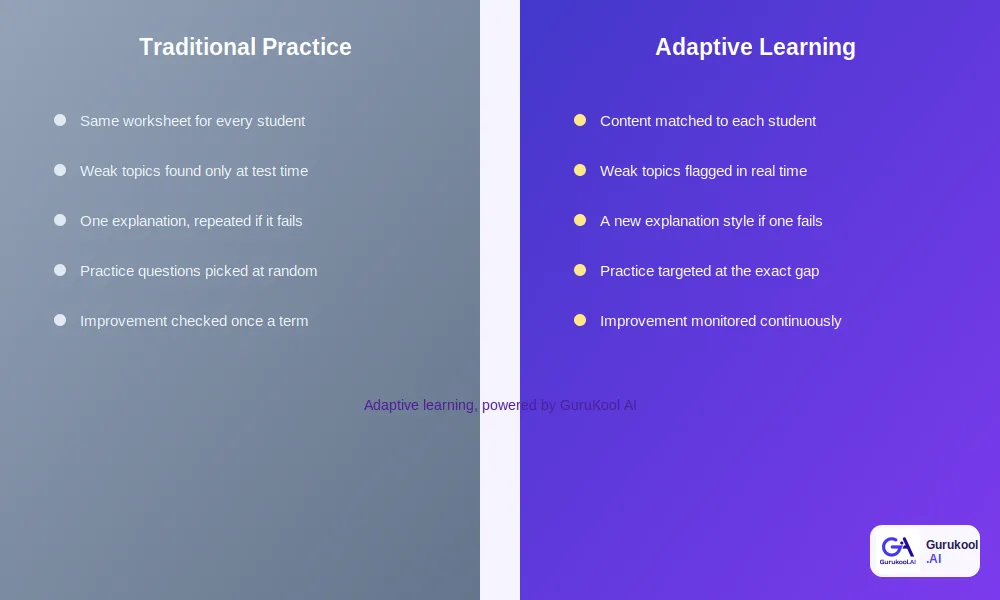
Adaptive learning compared to fixed, one-size-fits-all practice
| Factor | Traditional Practice | Adaptive Learning (GuruKool AI) |
|---|---|---|
| Content selection | Same worksheet for everyone | Matched to each student’s gaps |
| Weak topic detection | Found at test time | Flagged in real time |
| Response to a wrong answer | Same explanation repeated | A new explanation style offered |
| Practice questions | Random or sequential | Targeted at the exact weak skill |
| Progress checks | Once per term | Continuous, automatic |
Speed of Feedback
Traditional practice tells a student they got something wrong. This approach tells them why, and immediately offers a different way to understand it, all within the same study session instead of days later. That gap, minutes versus days, is often the real difference between a student who fixes a misunderstanding and one who simply memorizes a workaround without ever resolving it.
Practice Quality
Ten questions targeted at an actual weak spot are worth more than fifty questions spread randomly across topics a student already knows well. This targeted approach concentrates effort where it actually moves the needle. It also respects a student’s time, which matters on a school night when there are four other subjects competing for the same hour of study.
How GuruKool AI Powers Adaptive Learning
GuruKool AI applies the adaptive learning loop automatically, across every subject a student studies, without requiring a parent or teacher to manually configure anything. The same five-step process runs quietly in the background whether a student is reviewing history notes or working through a calculus problem set.
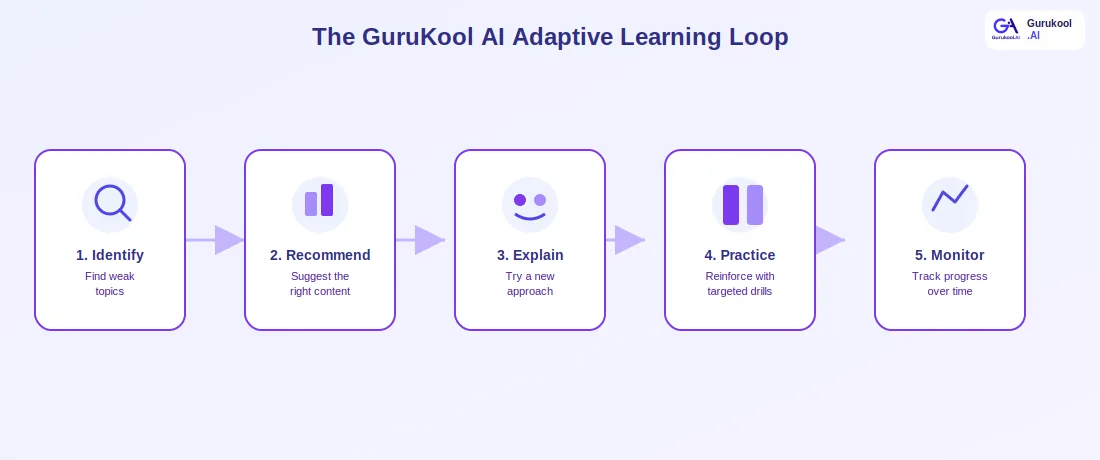
The five-step adaptive learning loop inside GuruKool AI
Identifying Weak Topics Automatically
As a student works through questions and conversations with the AI Tutor, GuruKool AI builds a live map of strong and weak topics, updating it after every interaction instead of waiting for a scheduled test. This map covers every subject the student studies on the platform, so a weak spot in chemistry does not get lost simply because most of the week’s attention went to a history assignment.
Recommending the Right Content Next
Once a weak topic is flagged, the Smart Library surfaces curriculum-aligned material specific to that gap, so a student spends time on what actually needs work instead of scrolling through unrelated content. The recommendation also respects what grade level and syllabus the student is following, so the suggested material lines up with what will actually appear on a school test rather than a generic version of the topic.
Explaining the Same Concept in a New Way
If a first explanation does not land, the Interactive Whiteboard and AI Tutor switch approaches, offering a visual breakdown, a simpler analogy, or a step-by-step walkthrough instead of repeating the same wording that already failed once. This matters most for concepts students describe as “clicking” only after seeing them drawn out, since no amount of re-reading the same paragraph achieves the same result for a visual learner.
- Identifies weak topics automatically from real study activity
- Recommends relevant content matched to the exact gap
- Explains concepts differently when the first attempt does not land
- Provides continuous practice targeted at the weak skill
- Monitors improvement over time through Learning Analytics
Ready to see it identify a real weak spot? Start a free GuruKool AI trial today.
Adaptive Learning in a Real Study Session
It helps to see the five-step loop play out in an ordinary study session rather than as an abstract idea.
Before Adaptive Learning
A seventh grader is working through a chapter on fractions using a printed worksheet. She gets several questions wrong in a row, but nothing in the worksheet flags this. She moves on to the next chapter still carrying the same misunderstanding, which resurfaces weeks later in a much harder topic that depends on it. By the time a teacher notices the pattern on a graded test, the gap has already had several weeks to spread into other areas of the subject.
After Adaptive Learning
The same student works through the same fractions chapter inside GuruKool AI. After three incorrect answers on a related skill, the system flags the gap immediately, recommends a short explainer using visual fraction bars instead of text, and follows up with five targeted practice questions. By the end of the session, her accuracy on that specific skill has visibly improved, and the dashboard reflects it the same day rather than the same semester. Her teacher and parent can see the exact same progress update without needing to wait for a report card or schedule a separate meeting to ask how things are going.
Frequently Asked Questions About Adaptive Learning
What is adaptive learning in simple terms?
Adaptive learning is a technology approach where content difficulty, format, and sequence adjust automatically based on how a student performs. Instead of a fixed lesson plan, the system reacts to each answer, identifying weak topics and adjusting what comes next to match the student’s actual understanding in real time.
How is adaptive learning different from personalized learning?
Personalized learning is the broader goal of matching pace, depth, and format to an individual student. Adaptive learning is the specific software mechanism that makes real-time adjustments possible. Adaptive learning is one of the main tools used to deliver personalized learning, not a separate, competing concept.
Does adaptive learning actually improve test scores?
Yes, in many documented cases. One well-known study on an adaptive learning program found a 62 percent improvement in test scores compared to students who did not use it, and a scoping review of higher education research found improved academic performance in the majority of studies reviewed.
How does GuruKool AI identify a student’s weak topics?
GuruKool AI tracks how a student answers questions and interacts with the AI Tutor across every session, building a live map of strong and weak areas. When a pattern of struggle appears on a specific skill, the platform flags it automatically and adjusts recommendations without needing manual input from a teacher or parent.
Is adaptive learning suitable for all subjects?
Adaptive learning works especially well for subjects with clear, sequential skills, such as math, language learning, and science, where one concept builds directly on another. It is equally useful for exam preparation, where identifying and closing specific gaps quickly has a direct, measurable impact on scores.
Conclusion
Adaptive learning is not about making studying harder or easier across the board. It is about making sure every minute of practice actually targets what a student needs next, instead of repeating what they already know or skipping past what they do not. With documented test score gains as high as 62 percent in some programs, this is one of the more measurable benefits AI in education has delivered so far, and it is a big part of why the personalized learning conversation keeps circling back to it.
GuruKool AI runs this five-step loop, identify, recommend, explain, practice, monitor, automatically in the background of every study session, so the adjustment happens without anyone needing to configure it manually. Whether the subject is algebra, chemistry, or a foreign language, the same underlying process quietly keeps pace with wherever the student actually is.
See adaptive learning find a real weak spot in minutes. Start a free GuruKool AI demo today.
Sources: ScienceDirect, AI-Enabled Adaptive Learning Platforms: A Review; Business Research Insights, Adaptive Learning Market Outlook.
Related reading: the core benefits of AI in education, where AI in education is headed next, and what personalized learning actually means.