A family paying for private tutoring twice a week at forty dollars an hour spends somewhere between 3,200 and 4,800 dollars over a single school year. A subscription to an AI tutor typically costs between zero and 300 dollars over that same year. That gap alone explains why so many families are now weighing AI tutor vs human tutor as a real decision rather than an obvious choice, especially with more than one child or subject to plan around. This guide walks through exactly how the two compare, where each one still wins, and how to decide which fits a specific family’s situation without guessing.
If you have already read our guide on what an AI tutor actually is, you know the category has moved well past simple chatbots. This post goes deeper into the specific comparison between an AI tutor and a traditional human tutor, covering cost, availability, and teaching quality side by side, with real numbers rather than vague impressions.
Why This Comparison Matters Now
This decision used to be simple by default: families who could afford a tutor hired one, and families who could not went without extra help entirely. That binary choice no longer holds, which is exactly why the comparison deserves a closer look than a quick gut reaction.
Software-based tutoring was a novelty a few years ago. It is now a genuine alternative that millions of families use every week, which makes the comparison against a traditional tutor worth taking seriously instead of dismissing either option outright.
The Rise of the AI Tutor
An AI tutor was a novelty a few years ago. It is now a genuine alternative that millions of families use every week, which makes the comparison against a traditional tutor worth taking seriously instead of dismissing either option outright. The global private tutoring market reached roughly 131 billion dollars in 2025 and is projected to grow to nearly 209 billion dollars by 2030, and a meaningful share of that growth is coming from AI tutor platforms rather than additional human tutors entering the market. Families are not necessarily spending less on support overall. They are increasingly choosing where that spending goes, and an AI tutor is capturing a growing share of that decision. This shift is not limited to any one country or income bracket either; it shows up across public and private schools alike, wherever families have any internet access at all.
What Parents and Students Are Actually Choosing Between
In practice, this rarely comes down to a single, permanent decision. Most families end up choosing a mix: an AI tutor for daily homework questions and routine practice, and a human instructor for deeper, ongoing support in one or two harder subjects. Understanding the strengths of each option makes that mix easier to plan intentionally instead of by accident, and it usually means neither option needs to be dismissed entirely. The families who feel most satisfied with their choice tend to be the ones who picked deliberately, based on their actual weekly routine, rather than defaulting to whatever their neighbor or classmate happened to be using.
Curious what this looks like for your household? Try GuruKool AI’s tutoring feature free and compare it against your current routine.
AI Tutor vs Human Tutor: Availability and Access
Availability is usually the first practical difference families notice, long before cost or teaching quality enter the conversation. It is also the difference that shows up most often in real, lived complaints from parents helping with homework after dinner.
24/7 Access, No Appointment Required
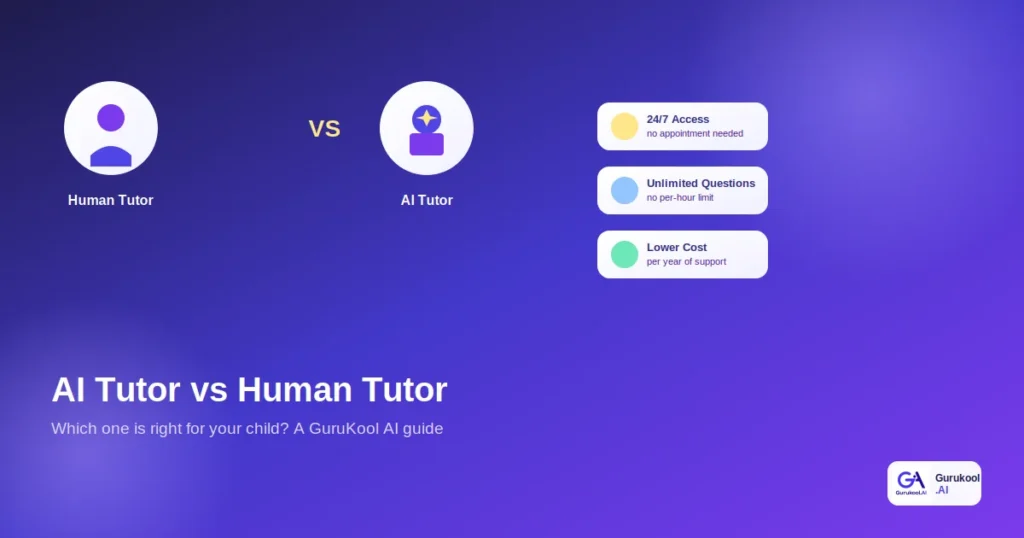
An AI tutor is available the moment a question comes up, whether that is nine in the morning or eleven at night before an exam. There is no calendar to check, no message to send asking if a slot is free, and no waiting for a reply. This single difference is often the deciding factor for families whose homework crunch time never lines up neatly with a tutor’s open hours.
Fixed Schedules and Waitlists for a Human Tutor
A qualified human tutor typically works on a fixed weekly schedule, often booked out days or weeks in advance during exam season. That structure works well for planned, recurring support, but it does very little for the question that comes up at ten at night with a test the next morning, which is exactly the gap an AI tutor is built to fill.
AI Tutor vs Human Tutor: Cost Over a School Year
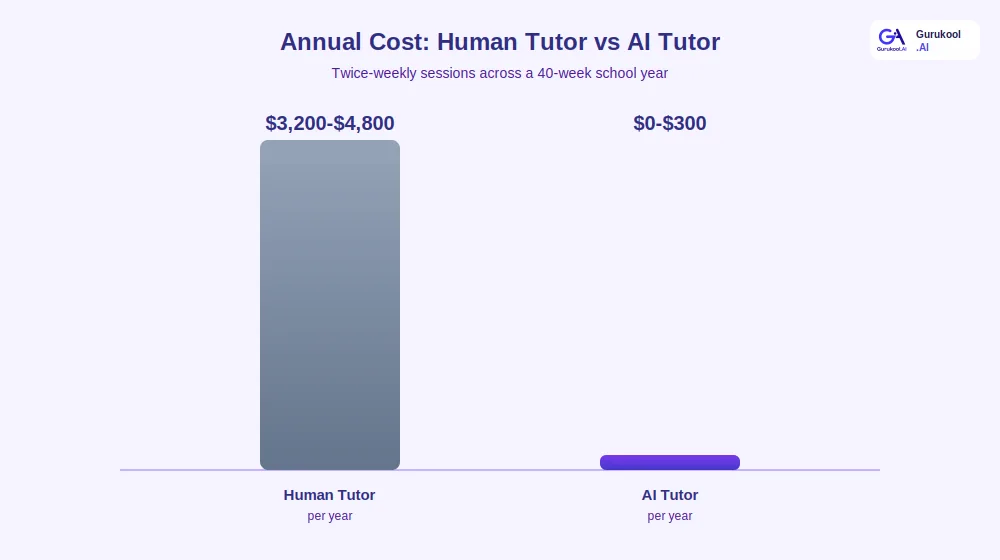
Cost is where the two options diverge the most dramatically, and the numbers are worth seeing side by side rather than as vague impressions. Most parents have a rough sense that private lessons are expensive and that apps are cheap, but few have actually lined up the annual totals against each other.
Annual cost: a traditional tutor compared to a software-based option
What a Human Tutor Typically Costs
Private tutoring in the US typically runs between 25 and 80 dollars an hour, with specialized subjects and test prep often landing at the higher end. Twice-weekly sessions across a standard 40-week school year add up to roughly 3,200 to 4,800 dollars annually, before accounting for cancellations, rescheduling, or a rate increase mid-year. Multiply that across two or three children, and the annual total quickly becomes one of the larger line items in a family’s education budget.
What an AI Tutor Typically Costs
An AI tutor subscription generally costs between zero and 300 dollars a year, with many offering a free tier and premium plans in the 10 to 30 dollar per month range. For a family managing more than one child or more than one subject, that difference in total annual spending is not small, and an AI tutor subscription typically covers every subject and every child under one plan rather than charging per session.
See exactly what this could save your family. Compare GuruKool AI’s pricing against your current tutoring budget.
AI Tutor vs Human Tutor: Teaching Quality and Personalization
Cost and availability matter, but teaching quality is ultimately what determines whether either option actually helps. A cheap, always-available tool that explains things poorly is not actually a bargain, and neither is an expensive tutor who cannot connect with a particular student.
Unlimited Questions Without Judgment
A student can ask an AI tutor the same question five different ways without worrying about wasting a paid hour or feeling embarrassed about not understanding it the first time. That freedom to ask, re-ask, and ask again tends to surface confusion a single hour-long session might not catch, and it removes the social pressure some students feel when a human tutor is watching the clock and mentally tracking billable minutes.
Visual Learning and Personalized Explanations
A strong AI tutor adjusts explanations to the individual, offering diagrams, simpler analogies, or a completely different approach if the first attempt does not land, echoing many of the same personalization principles covered in our guide to what personalized learning actually means. A human tutor can do this too, but consistency varies far more from person to person than it does across sessions with the same AI tutor.
Where a Human Instructor Still Wins
Motivation, emotional support, and reading a student’s body language during a tough session are still areas where a real person has a clear edge over an AI tutor. A human instructor can sense frustration building and adjust tone, pace, or even switch topics entirely in a way software still struggles to replicate reliably. For a student preparing for a high-stakes interview or presentation, rehearsing in front of an actual person also carries a kind of pressure and feedback that a screen simply cannot recreate.
Full Comparison Table: AI Tutor vs Human Tutor
Here is the complete picture across every factor covered so far, gathered into one place so it is easy to weigh at a glance instead of flipping back through separate sections.
| Factor | Human Tutor | Software-Based Option (GuruKool AI) |
|---|---|---|
| Availability | Fixed weekly schedule | Available 24/7, no appointment required |
| Questions per session | Limited by paid hour | Unlimited questions |
| Response speed | Wait for the next session | Instant answers, any time |
| Annual cost (typical) | $3,200-$4,800 | $0-$300 |
| Personalization | Depends on the individual tutor | Automatically adjusts explanations |
| Visual explanations | Varies by tutor’s teaching style | Built-in interactive whiteboard |
| Emotional support | Strong, human connection | Limited compared to a person |
| Motivation and accountability | Stronger, ongoing relationship | Consistent, but less personal |
See both sides for yourself. Start a free GuruKool AI trial and judge the fit firsthand.
How GuruKool AI Combines the Best of Both
Rather than framing this as a strict either-or choice, GuruKool AI is built to cover the gaps a traditional schedule cannot, while leaving room for human support where it still matters most. The goal is not to win the argument on paper, but to actually fit into how a family already studies, without asking anyone to rearrange their entire routine around a new tool.
A quick checklist for deciding between the two options
Instant Answers, Personalized Like a Tutor
GuruKool AI’s AI Tutor answers questions step by step, remembers what has already been explained, and adjusts explanations to how a student is actually responding, closer to a real tutoring relationship than a single-shot chatbot reply. This is the difference between an AI tutor that simply generates text and one that behaves like it is actually paying attention to the student in front of it.
When to Still Bring In a Human Instructor
For a student who needs sustained motivation, a college application essay reviewed by an experienced mentor, or support through a genuinely difficult personal stretch, a human instructor remains the better fit. An AI tutor is designed to handle everything in between, which for most families covers the majority of day-to-day studying, leaving human tutoring time for the moments that genuinely need it. Treating the two as complementary rather than competing tends to produce the best outcome for the actual budget and the actual student, rather than forcing an all-or-nothing choice neither option was really designed to win alone.
Choosing What’s Right for Your Situation
Rather than treating this as an abstract debate, it helps to work through a short, practical checklist grounded in an actual family’s routine and budget rather than a generic recommendation that ignores both.
A Family Weighing the Decision
Consider a family with two children in different grades, a tight monthly budget, and homework questions that tend to surface at inconvenient hours, usually right after dinner when everyone is already tired. Hiring two separate private instructors would run well past four thousand dollars a year combined. A single AI tutor subscription covers both children across every subject at a fraction of that cost, while an occasional paid session with a specialist remains an option for a specific, harder unit. Over a full year, that combination often ends up costing less than hiring one human tutor for one child alone.
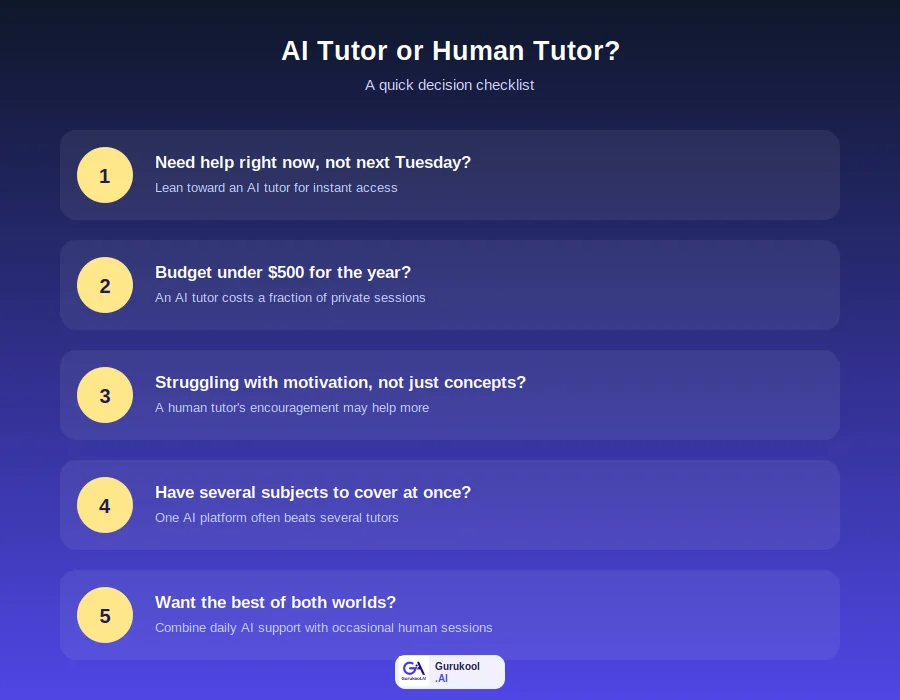
A short checklist can help clarify the decision:
- Is the need urgent, showing up outside normal tutoring hours? Lean toward the software option.
- Is the annual budget under roughly 500 dollars? A subscription-based approach fits better.
- Is the struggle mostly about motivation rather than understanding? A human instructor may help more.
- Are there multiple children or subjects to cover at once? One platform often beats several separate tutors.
- Would a combination work best? Many families land here, using both together.
None of these questions has a universally correct answer. A family with one child in a single struggling subject might reasonably land on a human tutor as the better long-term investment, while a family juggling four subjects across two children almost always finds more value in a single flat-rate subscription that covers everything at once.
Testing Both Before Committing
Most AI tutor platforms, including GuruKool AI, offer a free trial, which makes this an easy decision to test rather than guess. Spending a week actually using the tool on real homework tells a family far more than any comparison article, including this one, ever could on its own.
Frequently Asked Questions About AI Tutor vs Human Tutor
Is an AI tutor actually as good as a human tutor?
For structured subjects like math and science, research shows software-based tutoring can match or exceed human tutoring in measured learning gains. For motivation, emotional support, and open-ended mentorship, a human instructor still tends to have the edge. Most families find each option strong in different situations.
How much cheaper is an AI tutor than a human tutor?
Private human tutoring typically costs 3,200 to 4,800 dollars a year for twice-weekly sessions, while software-based subscriptions usually run between zero and 300 dollars annually. That is often a tenfold difference or more, which is one of the biggest reasons families are reconsidering their tutoring budgets.
Can I use an AI tutor and a human tutor at the same time?
Yes, and many families already do. A common pattern is using an AI tutor daily for homework help and routine practice, while reserving paid human sessions for a specific difficult subject or exam preparation period that benefits from deeper, ongoing mentorship and accountability that only a person can provide.
What does GuruKool AI offer that a basic chatbot does not?
GuruKool AI explains concepts step by step, remembers conversation context, and adjusts explanations to a student’s actual level, closer to how a real tutor teaches. It also adds an interactive whiteboard and voice conversations, which a general-purpose chatbot typically does not include.
Is a human tutor ever worth the extra cost?
Yes, particularly for motivation, accountability, and subjects requiring nuanced judgment, such as essay feedback or exam strategy coaching. For routine homework help and daily practice, the cost difference is harder to justify once a capable AI tutor is available, though a student who thrives on personal connection may still benefit from the extra spending.
Conclusion
AI tutor vs human tutor is not really a competition with one clear winner. A human instructor still offers something software cannot fully replicate: genuine motivation, emotional support, and judgment built on years of experience. An AI tutor offers something a human schedule cannot match: constant availability, unlimited questions, and a fraction of the annual cost.
GuruKool AI’s AI Tutor is built to cover the daily gap between tutoring sessions, so families can reserve human instructors for where they matter most instead of paying premium rates for every routine question. The goal is not choosing one permanently, but knowing which one to reach for in a given moment.
See which option actually fits your family. Start a free GuruKool AI demo today.
Sources: Bachu, AI Tutor vs Private Tutor: What’s the Real Cost?; Mentomind, Tutoring Pricing Guide 2026.
Related reading: what an AI tutor actually is, what personalized learning actually means, and how adaptive learning identifies and fixes weak topics.