Students who practice recalling a passage remember about 61 percent of it a week later, while students who simply re-read it remember about 40 percent, according to a classic study by Roediger and Karpicke. Yet most exam preparation still looks like highlighting and re-reading. AI for exam preparation can change that by turning your own notes into practice questions, showing you where you are weak, and answering doubts the moment they appear. It can also backfire. A 2024 Wharton field experiment found that students given unrestricted AI help solved 48 percent more practice problems but scored 17 percent lower on a later test without it.
This guide explains how to use AI for exam preparation as a coach rather than an answer key. It covers six ways AI helps, an eight-week countdown plan, and how GuruKool AI brings revision, practice, doubt-solving, summaries, weak-area tracking, and confidence-building into one place. If you have read our guide on how to study faster with AI, this post goes further and focuses on the specific demands of exam season.
Why Exam Preparation Often Fails Before It Starts
Most students do not struggle in exams because they did not work hard. They struggle because the work they did felt productive without being effective. Good exam preparation is less about the number of hours and more about how those hours are spent, and that is where most revision plans quietly go wrong.
Re-Reading Feels Productive but Isn’t
Re-reading creates familiarity, and familiarity feels like knowledge. The page looks easy the third time, so you assume you know it. The research says otherwise: in the Roediger and Karpicke study, recalling the material beat re-reading by roughly 21 percentage points after a week. Dunlosky and colleagues, in their well-known review, rated practice testing among the most useful study techniques and re-reading among the least. A common rule of thumb is to spend at least half of your exam preparation time on active recall, such as quizzes and practice questions, yet many students spend almost none.
Anxiety and Blind Spots Take Their Toll
Two other problems quietly hurt exam preparation. The first is not knowing what you do not know. Students tend to revise the topics they already like, which leaves weak areas untouched until it is too late. The second is anxiety. In a study of medical students preparing for a licensing exam, test anxiety was a significant negative predictor of performance. Practicing under realistic conditions, with quick feedback, is one of the few things that builds both skill and calm at the same time.
Time pressure makes this worse. Exam preparation competes with homework, activities, and sleep, so every wasted hour hurts. That is why the order of study matters: test first to find the gaps, then study what the test shows. A student who quizzes on Monday and revises the weak topics on Tuesday gets far more from the same exam preparation time than one who revises everything twice and tests only on the last night.
Want to see your own notes turned into practice questions? Try GuruKool AI free and start your exam preparation with a quick quiz.
What Is AI for Exam Preparation?
AI for exam preparation means using an AI system to support the parts of revision that are slow or hard to do alone: summarizing chapters, generating practice questions, explaining doubts, tracking weak areas, and planning review. It supports your effort. It does not replace it, and the difference decides whether the tool helps or hurts.
A Coach, Not an Answer Key
The Wharton experiment is a useful warning. Students with unrestricted AI help did well on practice problems and then did worse than students with no AI at all when tested without it. A version built to give hints instead of answers largely avoided the drop. The lesson is not to avoid AI. It is to use it the way you would use a good coach: ask it to quiz you, to explain the step you missed, and to check your reasoning, then try the next problem on your own. If the AI does the thinking, you will feel fast in practice and slow in the exam.
The Science Behind It: Retrieval and Spacing
Two ideas carry most of the weight in exam preparation research. Retrieval practice means testing yourself instead of re-reading. In a 2008 study in Science, Karpicke and Roediger found that repeated retrieval led to about 80 percent recall after a week, compared with about 36 percent for restudying. Spacing means revisiting material over days and weeks rather than all at once. A 2006 meta-analysis by Cepeda and colleagues, covering 184 articles and 317 experiments, found that spaced practice beats massed practice. AI makes both easier, because it can generate questions on demand and remind you when to revisit a topic.
6 Ways AI for Exam Preparation Helps You Succeed
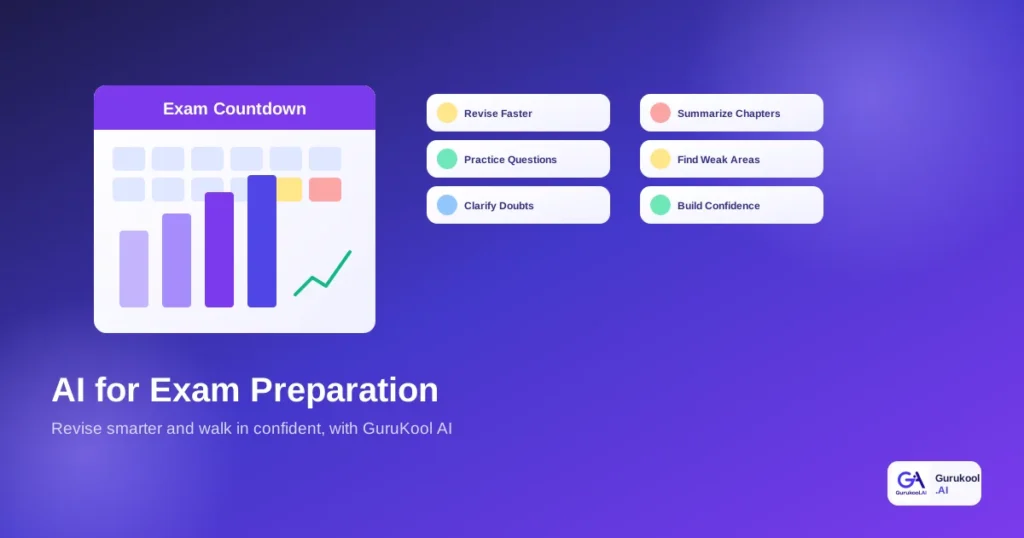
Six jobs account for most of the value, and each one is built into GuruKool AI.
- Revise faster: condensed notes and summaries in seconds
- Practice questions: unlimited quizzes built from your own material
- Clarify doubts: instant, step-by-step explanations
- Summarize chapters: key points ready to review
- Identify weak areas: results show where to focus next
- Improve confidence: familiarity built through timed practice
Revising Faster and Summarizing Chapters
An AI PDF reader condenses a chapter into its key points, and PDF annotation adds a revision summary and keyword list directly on the page. That saves hours of rewriting. Treat the summary as a map, not a destination. Reading it is passive, so follow it with a few questions on the same material. That small habit turns a fast summary into real exam preparation.
Practicing Questions and Clarifying Doubts
Practice questions are where most of the learning happens, because each one forces you to pull an answer from memory. An AI tutor can explain the exact step you missed, in plain language, the moment you miss it. Our guide to the AI homework helper explains how to work through a mistake and then practice similar questions until the pattern sticks.
Identifying Weak Areas and Building Confidence
Confidence is earned, not manufactured. It comes from having seen similar questions under similar conditions, and from knowing which topics are solid. Adaptive learning flags weak topics from your results, so you stop revising what you already know. Combined with personalized learning, it keeps your plan matched to your actual gaps rather than to a guess made weeks earlier.
Do not forget variety. Redrawing a diagram on an interactive whiteboard, or listening to a chapter through voice reading in a searchable AI library, gives you a different route to the same memory. Our guide on mobile learning shows how short sessions on a commute can add up across an exam season.
See all six in one place. Start a free GuruKool AI session and try a quiz, a summary, and a doubt-solving chat back to back.
AI for Exam Preparation vs Traditional Revision: A Comparison
Here is how AI-assisted exam preparation compares with traditional revision on the points that matter most in the weeks before a test.
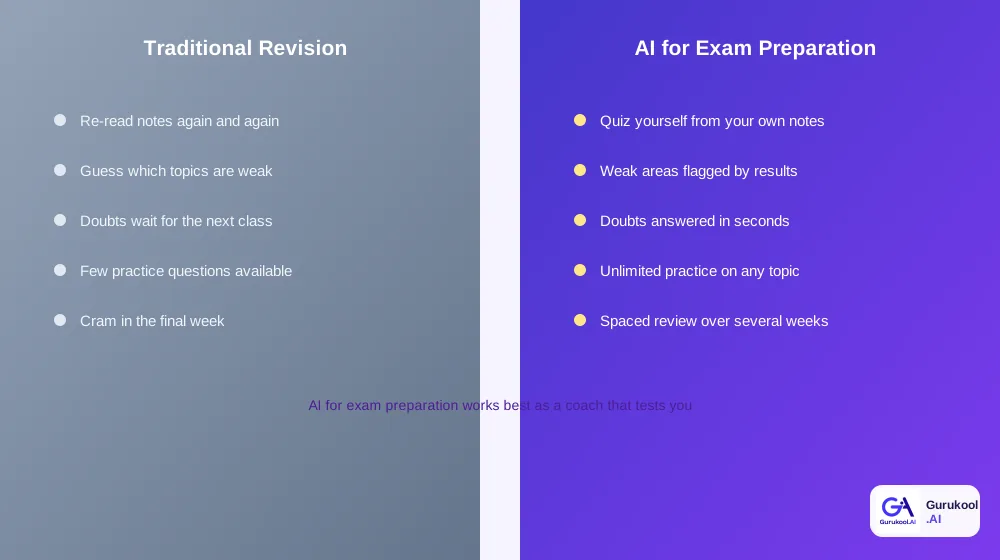
Traditional revision versus AI-assisted exam preparation
| Factor | Traditional Revision | AI for Exam Preparation (GuruKool AI) |
|---|---|---|
| Main method | Re-reading and highlighting | Quizzing yourself from your own notes |
| Weak areas | Guessed by feel | Flagged from your results |
| Doubts | Wait for the next class | Answered in seconds |
| Practice volume | Limited by available papers | Unlimited questions on any topic |
| Timing | Cramming in the final week | Spaced review across several weeks |
Feedback and Targeting
The biggest difference is feedback. With traditional revision, you often find out what you did not know after the test. With AI-assisted practice, you learn it within seconds, while there is still time to fix it. Targeting matters just as much. A short list of five weak topics is far easier to work on than a vague worry that you might not be ready.
Timing and Consistency
Spacing needs time, and AI helps you use it. Instead of one marathon session, you can review a few questions each day and revisit older material at growing intervals. That pattern fits the research on spaced practice, and it is also kinder to your schedule and your sleep, which matter more than most students admit during exam season.
It is worth being honest about limits. No app can fully recreate the pressure of a silent exam hall, so timed, closed-book practice is still essential. AI answers can occasionally be wrong, so check key facts against your textbook. And AI is for studying, never for cheating: using it during an exam where it is not allowed breaks the rules and defeats the purpose of exam preparation.
How GuruKool AI Supports Exam Preparation
GuruKool AI brings the tools students usually spread across several apps into one account, which keeps exam preparation simple enough to stick with for weeks.
Revision Tools in One Place
Upload a chapter and get a summary, highlights, and a keyword list. Ask the AI tutor about anything unclear, sketch a formula or diagram on the whiteboard, or listen to a chapter on the way to school. Because everything lives in the same account, the notes you made on Monday are still there on Friday, and the AI already knows which topics you have been asking about.
Practice That Targets Gaps
Quizzes are generated from your own material, so you practice what you actually studied. Results feed the analytics, which show which topics are strong and which need another pass, and practice recommendations point you to the weakest areas first. Set your own timer, close your notes, and answer as you would in the exam. Parents and teachers who use the platform can see the same progress, which makes conversations about preparation far more specific.
One note on trust: before relying on any study platform, including ours, ask how your data is stored and used. Students are entitled to clear answers, and a good platform will give them without fuss.
Build a plan around your weakest topics. Start a free GuruKool AI demo today.
An Exam Preparation Countdown in Action
A plan makes the difference between steady progress and a last-week panic. The eight-week countdown below uses four phases, and each one has a clear purpose.
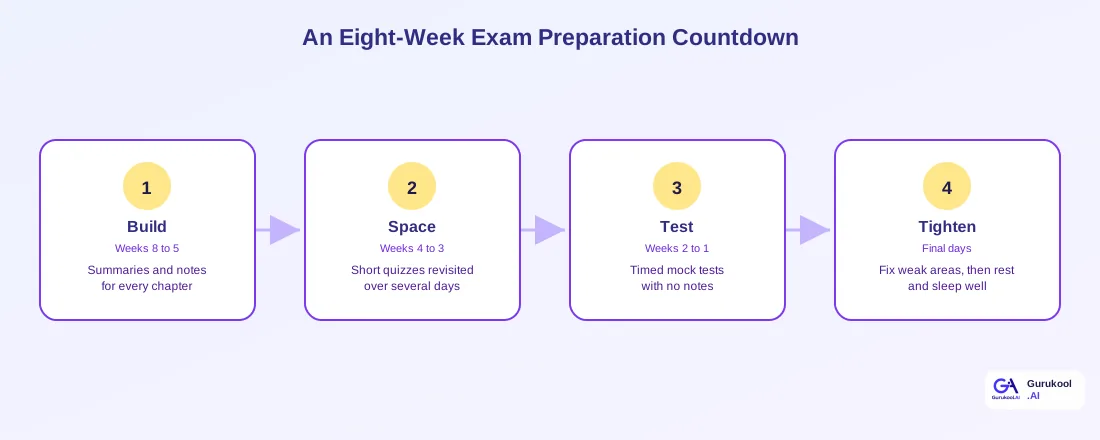
Build, space, test, and tighten
Weeks Eight to Three: Build and Space
A twelfth grader starts eight weeks before her finals. In the first few weeks, she uploads each chapter, reads the summary, and adds a few notes in her own words. She then asks the AI tutor about anything she cannot explain out loud. From week four, she takes a short quiz on each chapter every few days, so older topics keep returning before she forgets them.
The Last Fortnight: Test and Tighten
Two weeks out, she sits full practice sessions with a timer and no notes. After each one, she reviews every missed question and reads the explanation. The analytics point to two weak chapters, so she spends extra time there. In the final two days, she fixes small gaps, skims her summaries, and protects her sleep. She walks in knowing what to expect, which is exactly what builds calm.
The same countdown can be summarized in five steps:
- Summarize each chapter first, then add notes in your own words.
- Quiz yourself on a chapter every few days so older material returns.
- Ask the AI tutor to explain every question you miss.
- Sit timed, closed-book practice sessions in the last two weeks.
- Use your results to fix weak topics, then rest before the exam.
Parents and teachers can help without taking over. Ask to see the weekly results rather than the hours logged, and talk about the weakest topic instead of the final grade. Encourage breaks and sleep. Support like this makes exam preparation feel manageable, and it keeps the focus on progress instead of pressure, which is exactly what a nervous student needs.
Before wrapping up, here are answers to a few of the most common questions students ask about AI for exam preparation.
Frequently Asked Questions About AI for Exam Preparation
How can AI help with exam preparation?
AI can summarize chapters, turn your notes into practice questions, explain doubts step by step, flag weak topics from your results, and help you plan spaced review. It works best as a coach that tests you, rather than a tool that simply gives answers while you read along.
Is it okay to use AI to study for exams?
Yes, for studying. Using AI to summarize, quiz yourself, and understand mistakes is a legitimate study method. Using AI during an exam where it is not allowed is cheating. Also check your school’s rules, and verify important facts against your textbook, since AI answers can occasionally be wrong.
How early should I start exam preparation with AI?
Start as early as you can, ideally several weeks before the exam, because spacing your review over days helps memory more than cramming does. Even two weeks of short daily quizzes helps. A simple eight-week plan with build, space, test, and tighten phases works well for most students.
Can AI reduce exam anxiety?
It can help indirectly. Practicing under timed conditions builds familiarity, and knowing exactly which topics are solid reduces uncertainty. No app fully recreates real exam pressure, though. If anxiety feels overwhelming or affects your sleep or health, talk to a teacher, counselor, or doctor as well.
How does GuruKool AI help with exam preparation?
GuruKool AI combines chapter summaries, annotation, an AI tutor, a whiteboard, voice reading, quizzes from your own material, and analytics in one account. You can revise faster, practice on weak topics, clear doubts quickly, and see your progress, all without switching between separate apps.
Conclusion
AI for exam preparation works when it makes you do more remembering, not less. The research is clear that testing yourself and spacing your review beat re-reading, and the Wharton warning is clear that handing the thinking to a machine backfires. Use AI to summarize quickly, quiz you often, explain your mistakes, and show you where to focus, then do the recalling yourself. That is how exam preparation turns into steady progress and real confidence.
GuruKool AI brings revision, practice questions, doubt-solving, chapter summaries, weak-area tracking, and confidence-building into one platform, so AI for exam preparation becomes a calm weekly habit instead of a last-minute scramble.
Start your countdown with a plan, not a panic. Start a free GuruKool AI demo today.
Sources: PMC, Student-directed retrieval practice is a predictor of medical licensing examination performance; Evidence Based Education, Retrieval and Spaced Practice; MemX, Active Recall Meets AI: A Study System That Sticks.
Related reading: the best AI tools for students, how to study faster with AI, and the benefits of mobile learning.