A GovTech report found that nearly two thirds of K-12 schools and districts describe their key processes as mostly or fully paperless. Yet Hanover Research reports that just 19 percent of students say their teachers have taught them how to use AI for schoolwork, and 40 percent of K-12 employees say their school or district has no official AI policy. That mismatch captures the challenge of digital transformation in schools: the paperwork has gone digital faster than teaching, training, and learning have. Real digital transformation is not a purchase order for devices. It is a steady change in how a school teaches, supports students, and makes decisions.
This guide explains what digital transformation in schools involves, the six pillars that matter most, and how GuruKool AI supports each one: smart classrooms, AI teaching, interactive learning, paperless education, student analytics, and voice learning. If you have read our guide on AI for schools, this is the longer view, the roadmap that turns one good tool into a school that works differently.
Why Digital Transformation in Schools Is More Than Buying Devices
Most schools already own plenty of technology. Laptops, tablets, projectors, and learning platforms have been arriving for years. What many schools still lack is a clear picture of how all of it improves teaching. That is the difference between digitizing and transforming, and it is where most digital transformation plans either succeed or quietly stall.
Devices Are Not a Strategy
A device in every hand is a starting point, not a result. Digital transformation asks harder questions: what can students do now that they could not do before, and how does a teacher’s day actually change? The answers rarely come from hardware alone. They come from software that supports real teaching, training that gives staff confidence, and data that shows what is working. Hanover Research found that only 17 percent of teachers learned how to use data effectively during their preparation programs, which helps explain why schools often collect more data than they use.
The Backlash Against Screens Is a Useful Warning
Parents and educators are right to ask whether more technology means better learning. A University of Michigan survey of more than 68,000 educators found that bell-to-bell phone bans rose from 60 percent of schools in 2024-2025 to 74 percent in 2025-2026. That is a signal that schools want intentional technology, not constant screens. Good digital transformation respects that concern. It uses technology where it clearly helps, such as explaining a hard idea, giving feedback at the moment of need, or removing paperwork, and it leaves room for discussion, handwriting, and time away from screens.
Want to see what purposeful technology looks like in a classroom? Try GuruKool AI free and explore all six pillars in one place.
What Does Digital Transformation in Schools Really Involve?
Digital transformation in schools is the deliberate redesign of teaching, learning, and school operations around digital tools and data. The word deliberate matters. Moving a worksheet onto a screen is digitization. Using that screen to give each student instant feedback, and giving teachers a clear view of the whole class, is transformation.
Six Pillars, One Direction
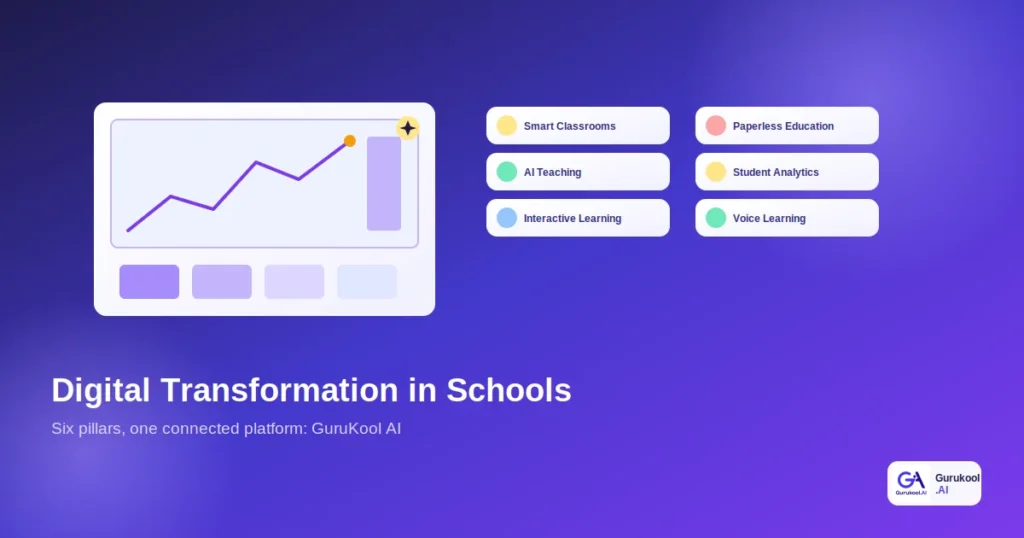
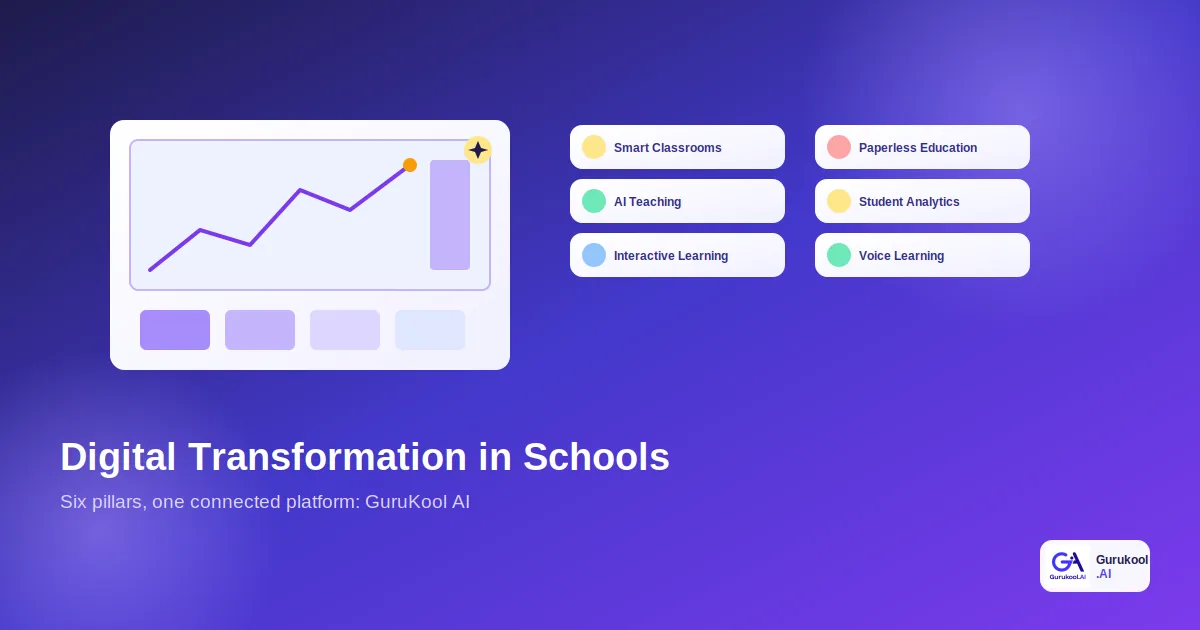
Six areas do most of the work: smart classrooms, AI teaching, interactive learning, paperless education, student analytics, and voice learning. Each one is useful alone, but the real gain comes when they share information. A paperless handout that also feeds analytics, an interactive lesson that adapts to student answers, and a voice option that helps a struggling reader are all stronger when they sit on the same platform. That shared foundation is what separates digital transformation from a drawer full of unconnected apps.
Where Most Schools Stall
Schools rarely stall because of technology. They stall because of people and process. When only 19 percent of students say teachers have taught them how to use AI, and 40 percent of K-12 employees report no official AI policy, it is clear that support has not kept pace with tools. Teachers who feel unsupported tend to try a new tool a few times and then return to what they know. A realistic plan therefore includes training, a short policy, and a clear owner for each stage of the work, not just a software license.
It also helps to treat digital transformation as a series of small, visible wins. A school that fixes one painful process, such as collecting and annotating reading handouts, earns trust for the next change. A school that announces a sweeping overhaul tends to meet quiet resistance. Leaders who succeed usually pick a starting point that teachers will notice within weeks, measure it honestly, and then use that result to explain why the next step is worth taking.
6 Pillars of Digital Transformation in Schools
These six pillars cover the parts of school life where technology changes the daily experience the most, and each one is built into GuruKool AI.
- Smart classrooms: connected spaces where teaching, content, and tools work together
- AI teaching: help with explanations, examples, and lesson preparation
- Interactive learning: visual, hands-on activities instead of passive reading
- Paperless education: documents, notes, and annotation kept digital and searchable
- Student analytics: clear data on progress and learning gaps
- Voice learning: listening and speaking as ways to learn and to access content
Smart Classrooms and Interactive Learning
A smart classroom is less about hardware than about connection. When the board, the content, and the tutoring tools share one platform, a teacher can draw an idea on an interactive whiteboard, save it with the digital whiteboard, and let students explore it again at home. Interactive learning turns students from listeners into participants. They draw, answer, and test ideas, and active participation tends to produce stronger understanding than passive reading or listening alone.
AI Teaching and Paperless Education
AI teaching covers the support that makes lessons easier to prepare and easier to follow. An AI tutor explains concepts step by step, and AI lesson planning gives teachers a first draft in minutes. Paperless education removes the friction of printing and filing. An AI PDF reader summarizes documents, and PDF annotation keeps highlights and notes on the page, searchable and shareable with a whole class.
Student Analytics and Voice Learning
Student analytics show where each learner stands, powered by adaptive learning that detects weak topics early. Voice learning widens access. Educators quoted by EdWeek in 2026 pointed to text-to-speech and dictation as real benefits for students with learning disabilities. A searchable AI library with voice reading lets any student listen to a chapter, and a large meta-analysis found no significant difference in comprehension between reading and listening for many learners.
A note on sequencing: you do not need to launch all six pillars at once. Paperless education and student analytics usually deliver the earliest visible gains, because they remove friction that teachers feel every week. AI teaching and interactive learning then deepen the classroom experience, and voice learning extends access to students who need it most. Starting in that order keeps digital transformation manageable and gives staff time to build confidence between stages.
See all six pillars working together. Start a free GuruKool AI session and try the whiteboard, tutor, and analytics back to back.
Digital Transformation vs Traditional Classrooms: A Comparison
Here is how a transformed classroom compares with a traditional one on the points that shape a typical school day.
A traditional classroom versus one shaped by digital transformation
| Factor | Traditional Classroom | After Digital Transformation (GuruKool AI) |
|---|---|---|
| Lessons | Static board and printed handouts | Connected, interactive lessons |
| Feedback | Arrives days after the work | Instant, while students learn |
| Documents | Printed, filed, and often lost | Digital, annotated, and searchable |
| Data | Mostly end-of-term test results | Continuous student analytics |
| Access | One way to read and learn | Text, voice, and visual options |
Teaching and Learning Experience
The biggest change is speed of feedback. In a traditional classroom, a student may wait days to learn that a method was wrong, by which time the mistake has been practiced many times. With transformed teaching, the AI tutor and quiz tools respond within seconds. Students correct misunderstandings while the lesson is still fresh, and teachers spend less time marking and more time helping.
Operations and Decision-Making
Digital transformation also changes how a school runs. Paperless workflows cut the time spent copying, filing, and searching. Analytics give leaders a continuous view of progress rather than a snapshot at the end of term. That shift lets a principal spot a struggling subject in October rather than discovering it in June, and it makes budget conversations far easier because they rest on evidence instead of anecdotes.
Cost deserves honest treatment. Savings from going paperless are real but usually modest, so the stronger case rests on time and learning. Ask what staff hours are recovered, how quickly students receive feedback, and whether the number of students falling behind is shrinking. A transformation that cannot answer those questions after a year deserves a closer look.
How GuruKool AI Supports Digital Transformation
GuruKool AI was designed so that a school can pursue digital transformation through one platform instead of stitching together six separate products.
One Platform Across the Six Pillars
The AI tutor, interactive whiteboard, PDF reader and annotation tools, smart library, learning analytics, and voice reading all live in one account. A teacher can prepare a lesson, annotate a reading, and teach it visually. Students can revisit the same explanation by voice or text at home. Analytics then show which parts landed, so the next lesson starts from evidence. Because every feature shares the same context, staff learn one system and leaders see one picture.
Digital Without Excess Screen Time
Transformation does not have to mean more screen time. GuruKool AI is built for purposeful use: the whiteboard supports a class discussion rather than replacing it, the AI tutor helps at the moment of confusion rather than filling idle minutes, and analytics help teachers decide where to spend their face-to-face time. Schools can pair the platform with their own device and phone policies, so technology serves teaching instead of competing with it.
Governance matters just as much. School leaders should know who can see which data, how long it is kept, and whether it is used to train models, and they should ask any vendor, including us, for clear written answers. A transformation built on trust lasts longer than one built on novelty, and families are far more willing to support tools they understand.
See how it fits your school. Request a free GuruKool AI demo for your leadership team today.
A Digital Transformation Roadmap in Action
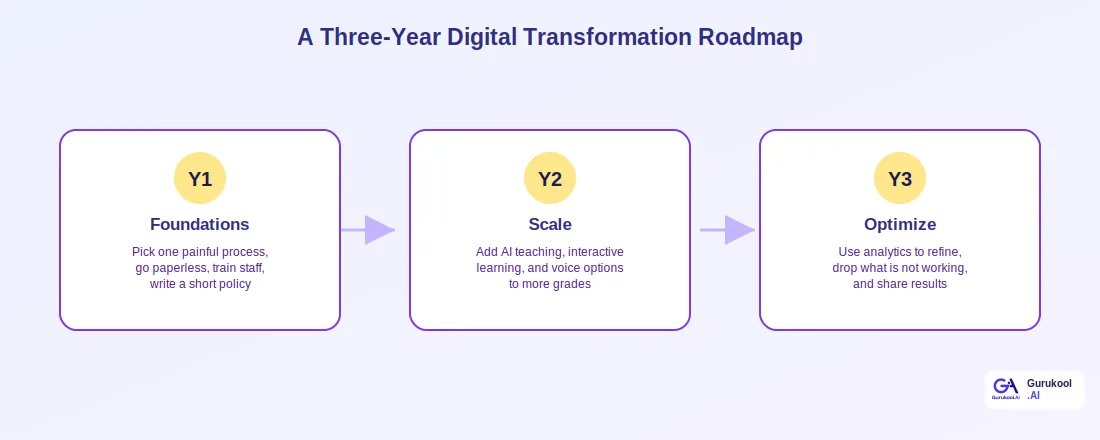
The schools that succeed treat digital transformation as a three-year journey, not a single launch day. Each year has a clear purpose, and each builds on the last.

Foundations, scale, and optimize
Year One: Foundations and Quick Wins
A secondary school starts with one painful process: collecting, marking up, and sharing reading handouts. It moves that work onto the platform, trains a first group of teachers, and writes a one-page policy covering data and acceptable use. Within a term, teachers notice the time saved, and students can find every handout in one place. That early, visible win builds trust for everything that follows.
Years Two and Three: Scale and Refine
In year two, the school adds AI teaching tools, interactive whiteboard lessons, and voice options for students who benefit from listening. By year three, analytics show which tools actually improve results. The school drops the ones that do not, shares what it learned with parents, and uses the data to plan support. That is digital transformation in schools at its best: not more technology, but better decisions about technology.
The journey can be summarized in five steps:
- Choose one painful process and fix it first.
- Train a small group of teachers and write a short policy.
- Add AI teaching, interactive learning, and voice options in the second year.
- Review the analytics each term to see what is genuinely working.
- Keep what helps, drop what does not, and share the results.
Before wrapping up, here are answers to a few of the most common questions school leaders ask about digital transformation.
Frequently Asked Questions About Digital Transformation in Schools
What is digital transformation in schools?
Digital transformation in schools is the deliberate redesign of teaching, learning, and operations around digital tools and data. It goes beyond buying devices to include smart classrooms, AI teaching, interactive learning, paperless workflows, student analytics, and voice learning, all supported by training and clear policy.
How long does digital transformation in schools take?
Most schools should plan for about three years. The first year focuses on foundations and one visible quick win, the second on scaling to more grades and tools, and the third on using analytics to refine. Rushing the process usually creates resistance and wasted purchases.
Does digital transformation mean more screen time?
Not if it is done well. The goal is purposeful technology, used where it clearly helps, such as instant feedback or accessibility, while protecting discussion, handwriting, and time away from screens. Many schools pair transformation with clear device and phone policies to keep technology in service of teaching.
How do schools measure whether digital transformation is working?
Choose a few clear measures before you begin, such as teacher hours saved, speed of student feedback, and the number of students falling behind. Review analytics each term and compare results with your starting point. If a tool cannot show impact after a year, reconsider it.
How does GuruKool AI support digital transformation?
GuruKool AI brings the AI tutor, interactive whiteboard, PDF reader and annotation, smart library, student analytics, and voice learning into one platform. Staff learn one system, students get consistent support, and leaders see shared data, which makes each stage of the roadmap simpler to run and review.
Conclusion
Digital transformation in schools is not about owning the newest technology. It is about using technology deliberately to change how students learn, how teachers spend their time, and how leaders decide. The schools that get it right start with one visible win, build trust, keep screen time purposeful, and let the data decide what stays. The schools that struggle tend to buy first and plan later. If you take one idea from this guide, make it this: choose the first win carefully, because it sets the tone for the rest of your digital transformation.
GuruKool AI gives schools smart classroom tools, AI teaching, interactive learning, paperless workflows, student analytics, and voice learning in one platform, so digital transformation becomes a clear, manageable journey rather than a collection of disconnected projects.
Start your school’s roadmap with one connected platform. Request a free GuruKool AI demo today.
Sources: Hanover Research, Top Trends for Boosting K-12 Student Outcomes in 2026-27; GovTech, How to Accelerate Digital Transformation for K-12 Education; Brighterly, Technology in the Classroom in 2026.
Related reading: why schools need AI, the best AI tools for teachers, and where AI in education is headed next.