By spring 2025, more than half of US students (54 percent) and core subject teachers (53 percent) were already using AI for school, according to RAND. Yet only 45 percent of principals said their school or district had any AI policy at all. That gap between daily use and clear guidance is the real story behind AI for schools in 2026. Schools no longer have to decide whether AI for schools is coming, because it is already in the building. The question is whether it arrives through scattered personal apps that nobody has vetted, or through one connected platform that leaders can see, guide, and measure.
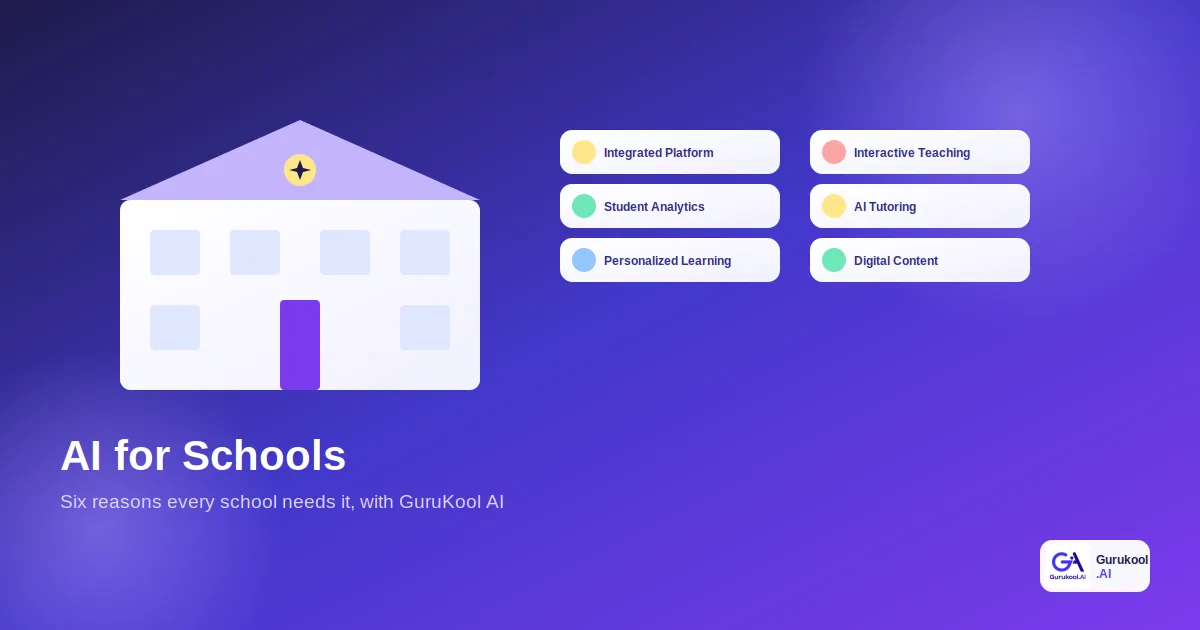
This guide explains why schools need AI, what to ask before choosing a platform, and how GuruKool AI gives schools six things in one place: an integrated learning platform, student analytics, personalized learning, interactive teaching, AI tutoring, and digital content. If you have read our guides on AI tools for teachers and the best AI tools for students, this post is the school-wide view, written for principals, administrators, and technology leaders.
Why Schools Can No Longer Wait on AI
For years, school leaders could treat new technology as something to evaluate slowly. AI for schools does not allow that luxury. Students and teachers adopted it on their own, long before most schools had a plan, and the result is a patchwork of personal accounts, free tools, and unwritten rules that leaders cannot see or support.
Students Are Already Using It
RAND found that student and teacher use of AI grew by more than 15 percentage points in just one to two years, with high school students using it most often. When a school offers no approved option, students simply use whatever they find, and the school loses any chance to shape how it is used. Good AI for schools starts from that reality: the choice is not between AI and no AI, but between guided use and unguided use.
Guidance and Training Are Lagging
The same RAND research found that only 35 percent of district leaders said their schools provided students with any training on using AI, and just 34 percent of teachers reported policies on AI and academic integrity. The picture for AI for schools is improving fast. The Consortium for School Networking found in 2026 that 79 percent of districts now have AI guidelines, up from 57 percent a year earlier. Even so, a policy on paper is not the same as a tool that staff can actually use well.
Want to see what a connected, school-ready platform looks like? Try GuruKool AI free and explore it from a leader’s point of view.
What Does AI for Schools Actually Mean?
AI for schools means using artificial intelligence across teaching, learning, and school operations in a way that leaders can govern. It is more than a chatbot pilot in one classroom. It is a set of tools, rules, and data that work together so that students get better support, teachers get time back, and leaders get a clear view of what is working.
Beyond a Chatbot Pilot
Many schools begin with a single AI chatbot and a handful of enthusiastic teachers. That is a reasonable start, but a lone chatbot rarely scales into real AI for schools. Real AI for schools covers tutoring, interactive teaching, personalized practice, and analytics, and it works for students, teachers, and administrators from one account. Without that wider scope, a pilot tends to fade once the early enthusiasm passes, which is exactly what happens to many digital tools.
What School Leaders Should Ask Before Adopting
Privacy matters as much as features. FERPA, the federal law covering student records, dates back to 1974, long before AI tools existed, and states are now writing their own rules. Ohio, for example, required every public district to adopt a formal AI policy by July 1, 2026. Whichever platform you consider, including ours, ask where student data is stored, whether it is used to train models, who can see it, and how long it is kept. In the CoSN survey, 98 percent of technology leaders said they were concerned about AI-related cyber risks, so these questions deserve clear written answers.
There is also a trust question to address openly. RAND found that 61 percent of parents and 55 percent of high school students believe more AI use could harm students’ critical thinking, while only 22 percent of district leaders agreed. That gap matters. Leaders planning AI for schools should treat parent and student concern as useful feedback, not as resistance. The best response is design, not reassurance: choose AI for schools that explains steps instead of simply giving answers, keeps teachers in charge, and shows families exactly how it is used. When people can see the safeguards, support for AI for schools tends to grow.
6 Reasons AI for Schools Matters in 2026
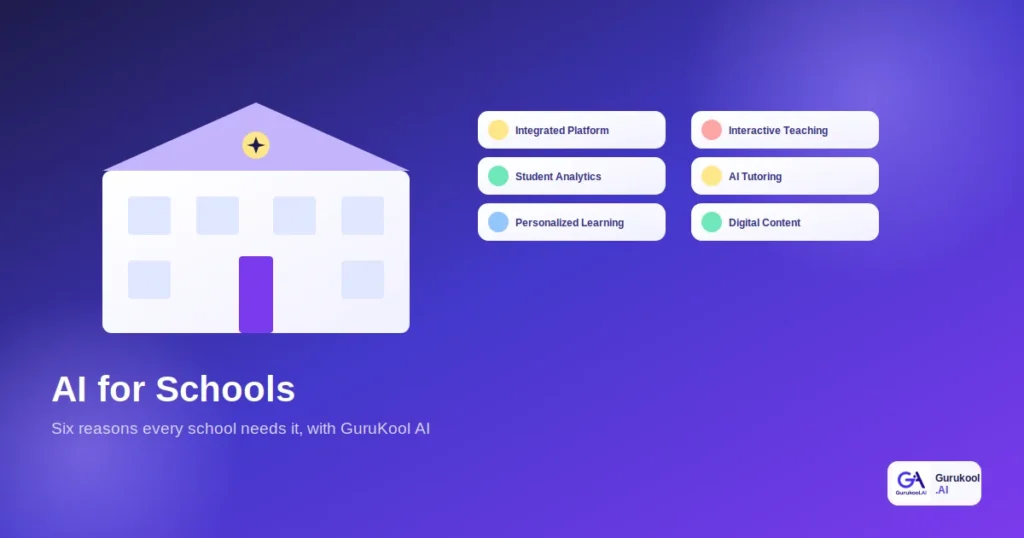
Six reasons come up again and again when school leaders explain why they are investing in AI for schools, and each one maps to something GuruKool AI provides.
- One integrated learning platform instead of a pile of separate tools
- Student analytics that show where learning is working and where it is not
- Personalized learning that adjusts to each student’s pace
- Interactive teaching with visual, hands-on explanations
- AI tutoring that gives every student help beyond school hours
- Digital content that is organized, searchable, and always available
One Integrated Platform Instead of Tool Sprawl
Schools collect digital tools the way attics collect boxes. A survey summarized by Programs.com found that almost two thirds of school administrators say they have stopped using a digital learning tool after piloting or adopting it, and the most common reason is that it failed to improve outcomes. An integrated approach to AI for schools avoids much of that waste, because training, contracts, and data live in one place. Our guide on the future of AI in education explains why consolidation is where the market is heading.
Analytics, Personalization, and Interactive Teaching
Student analytics turn scattered quiz results and tutoring sessions into a readable picture of each class. Personalized learning and adaptive learning then adjust practice to what each student actually needs. For the teacher at the front of the room, an interactive whiteboard makes abstract ideas visible, and AI lesson planning cuts the preparation time behind every lesson.
AI Tutoring and Digital Content for Every Student
An AI tutor gives students help at the moment they get stuck, at a cost that private tutoring cannot match, as we show in our comparison of an AI tutor and a human tutor. A smart library keeps digital content organized, searchable, and aligned with the curriculum, so material is easy to find and easy to trust.
See all six reasons in one platform. Start a free GuruKool AI session and walk through it with your leadership team.
AI for Schools vs Fragmented EdTech: A Comparison
Here is how integrated AI for schools compares with a collection of separate tools on the factors leaders care about most.
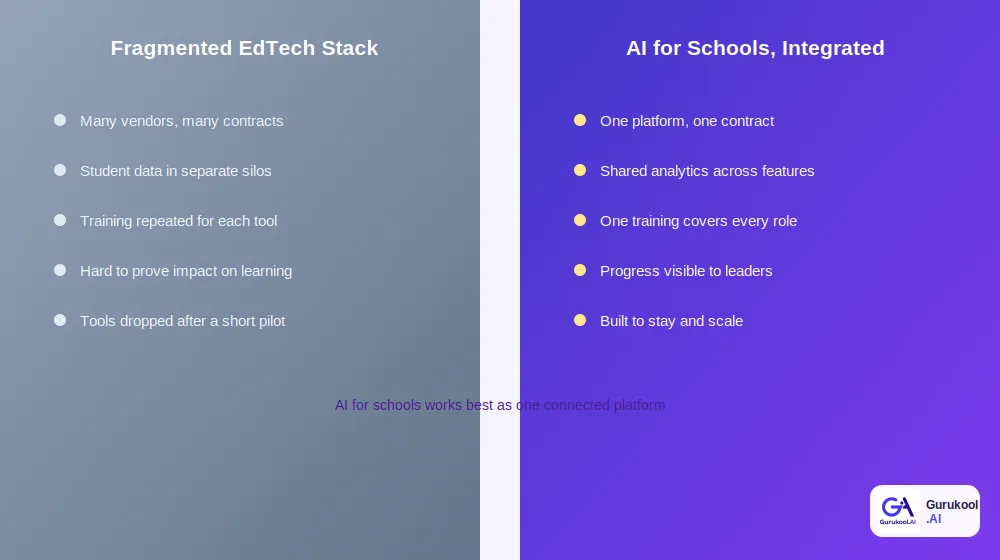
A fragmented edtech stack versus one integrated platform
| Factor | Fragmented EdTech | Integrated AI for Schools (GuruKool AI) |
|---|---|---|
| Vendors and contracts | Many, each renewed separately | One platform, one contract |
| Student data | Spread across separate systems | Shared analytics across features |
| Staff training | Repeated for every new tool | One training covers every role |
| Proof of impact | Hard to assemble | Progress visible to leaders |
| Long-term fit | Often dropped after a pilot | Built to stay and scale |
Cost and Procurement
Every extra vendor adds a contract, a security review, and a renewal date. A single AI for schools platform shortens that cycle and makes the total cost easier to explain to a board. It also reduces the quiet cost that many schools forget, which is the staff time spent learning and supporting one more login.
Data and Decision-Making
When student data sits in many systems, nobody can answer simple questions, such as which students are falling behind across subjects. A connected platform keeps that information together, so leaders can plan support using evidence. This is where AI for schools moves from a classroom convenience to a tool for school improvement.
A useful test for any purchase is to define the outcome before the product. Decide what you want to change, such as fewer students falling behind in math or less time spent on lesson preparation, and then ask how the platform will show progress toward it. Strong AI for schools should provide that evidence without extra reports. If a vendor cannot explain how impact will be measured, treat that as a warning sign. Choosing AI for schools this way keeps the focus on learning, which is the most common reason districts give for dropping tools that never delivered.
How GuruKool AI Serves Schools
GuruKool AI was built so that one platform serves the whole school community, which keeps AI for schools simple to adopt, simple to train for, and simple to review.
One Platform for Students, Teachers, and Leaders
Students use the AI tutor, whiteboard, PDF reader, and library to study. Teachers use the same platform to prepare lessons, annotate documents, and monitor progress. Leaders see the analytics that tie it together. Because everyone works from the same account and the same content, an explanation given in class is the same one a student can revisit at home, and a question asked at night can inform what a teacher covers the next morning. That consistency is what makes AI for schools easy to explain to families.
Equity and Access for Every Student
Access to AI is not evenly spread. RAND found that 67 percent of low-poverty districts had trained teachers to use AI, compared with just 39 percent of high-poverty districts. Tutoring support is also uneven, since private tutoring costs thousands of dollars a year. Well-designed AI for schools offers AI tutoring, digital content, and personalized practice through the school, which gives every student the same help, whether or not their family can pay for it.
Governance is built in rather than bolted on. School leaders decide who can see which data, teachers keep control over what students receive, and every feature works from the same account. That structure supports a school’s own policy instead of working around it. For leaders, the practical benefit is that AI for schools becomes something you can describe to parents in a single paragraph: what the tools do, who sees the data, and how success will be measured. Clear answers like these build the trust that makes AI for schools last.
See how it works for a whole school. Request a free GuruKool AI demo for your school today.
A School Rollout in Action
Large rollouts of AI for schools fail when they try to do everything at once. A steady, four-phase approach gives staff time to learn and gives leaders evidence before each next step.
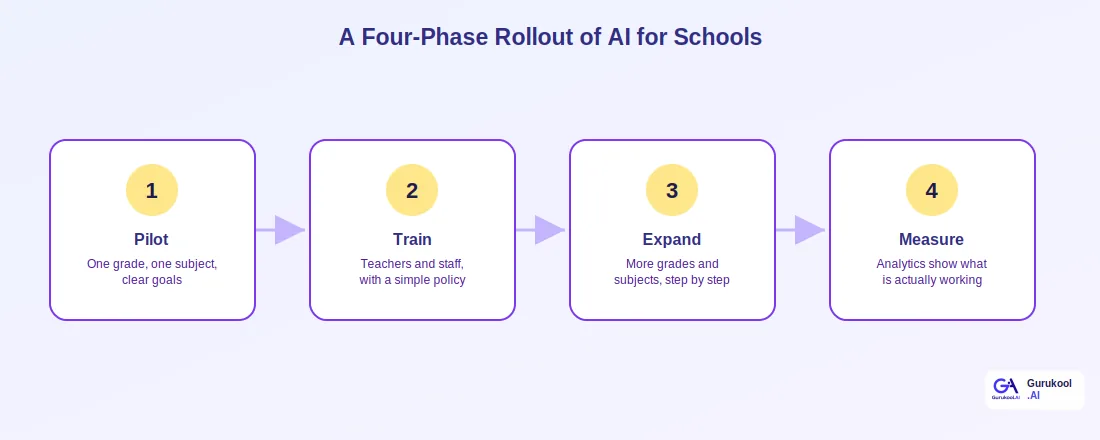
Pilot, train, expand, and measure
Starting Small With a Pilot and Training
A middle school begins with one grade and one subject. Leaders write a short, plain-language policy, hold a single training session for the pilot teachers, and set one clear goal, such as reducing the number of students who fall behind in math. Teachers use the AI tutor and whiteboard in class, and students use the platform for practice at home.
Expanding and Measuring
After a term, the analytics show which topics improved and which did not. The school adds two more grades, shares what teachers learned, and reviews the data again. Because the platform is integrated, the second phase needs no new contracts and no new logins, and leaders can report real results to parents and the board instead of general impressions.
The same rollout can be summarized in five steps:
- Choose one grade and one subject for a focused pilot.
- Write a short, clear policy and train the pilot teachers.
- Run the pilot for a full term and gather feedback from teachers and students.
- Review the analytics and decide what to keep, change, or drop.
- Expand to more grades, repeating the training and review cycle.
Before wrapping up, here are answers to a few of the most common questions school leaders ask about AI.
Frequently Asked Questions About AI for Schools
Why do schools need AI?
Students and teachers are already using AI, so schools need a guided approach to AI for schools rather than leaving use unmanaged. A school platform can offer tutoring, personalized practice, analytics, and teaching tools in one place, while giving leaders visibility into how AI is used and whether it improves learning.
Is AI safe for student data in schools?
It depends on the platform, so scrutinize any AI for schools product. Leaders should ask where data is stored, whether it trains AI models, who can access it, and how long it is kept. Look for clear written answers and compliance with privacy laws such as FERPA and COPPA before approving any tool.
Will AI for schools replace teachers?
No. Research consistently shows AI for schools works best when it handles preparation and routine support while teachers provide judgment, motivation, and human connection. AI can draft, explain, and track progress, but teachers still decide what to teach and how to respond to each student.
How should a school start with AI?
Start small. Choose one grade and one subject, write a short plain-language policy, train the pilot teachers, and set one measurable goal. Review the analytics after a term, then expand step by step. Focused AI for schools pilots give you evidence and avoid the waste of abandoned tools.
How is GuruKool AI different from using separate edtech tools?
GuruKool AI brings tutoring, interactive teaching, personalized learning, digital content, and analytics into one platform. Staff learn one system, leaders see shared data, and students get consistent support. Separate tools each hold a narrow slice of information, which makes training harder and impact harder to prove.
Conclusion
The case for AI for schools does not rest on hype. It rests on a simple fact: students and teachers are already using AI, and guidance is still catching up. Schools that choose a connected, well-governed platform can turn that scattered use into something they can support, measure, and improve. Schools that wait will still have AI in their classrooms, only without a plan. Done well, AI for schools is a plan rather than a gamble, and it starts with one clear goal.
GuruKool AI gives schools one integrated learning platform with student analytics, personalized learning, interactive teaching, AI tutoring, and digital content, so AI for schools becomes a steady, trackable part of the school day instead of a loose collection of experiments. Start with one grade, one goal, and one platform, and let the results guide what comes next.
Bring a plan, not a patchwork, to your school. Request a free GuruKool AI demo today.
Sources: RAND, AI Use in Schools Is Quickly Increasing but Guidance Lags Behind; EdSurge, Report: School IT Officials Worried About AI Adoption, Cybersecurity.
Related reading: the benefits of AI in education, the best AI tools for teachers, and how AI lesson planning saves teachers time.